We tested 14 home‑theater rules of thumb in 1,000 simulated rooms
Forums and buying guides repeat the same handful of rules. We ran them through the same room model as our subwoofer simulator, and checked the geometry ones against the standards.
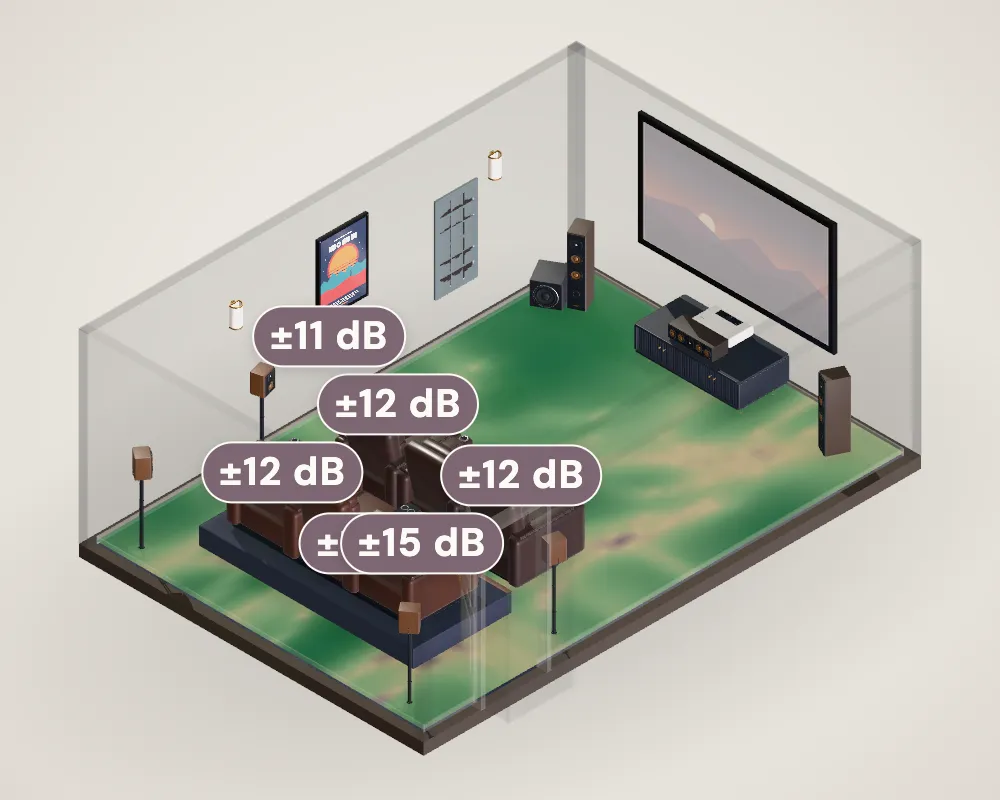
- Where you sit beats which “ideal” ratio your room has: up to 3 dB of difference against a quarter of a decibel.
- The 38% rule is half true: good from the front wall, among the worst from the back.
- Golden-ratio rooms are a myth; cubes and double squares really are worse.
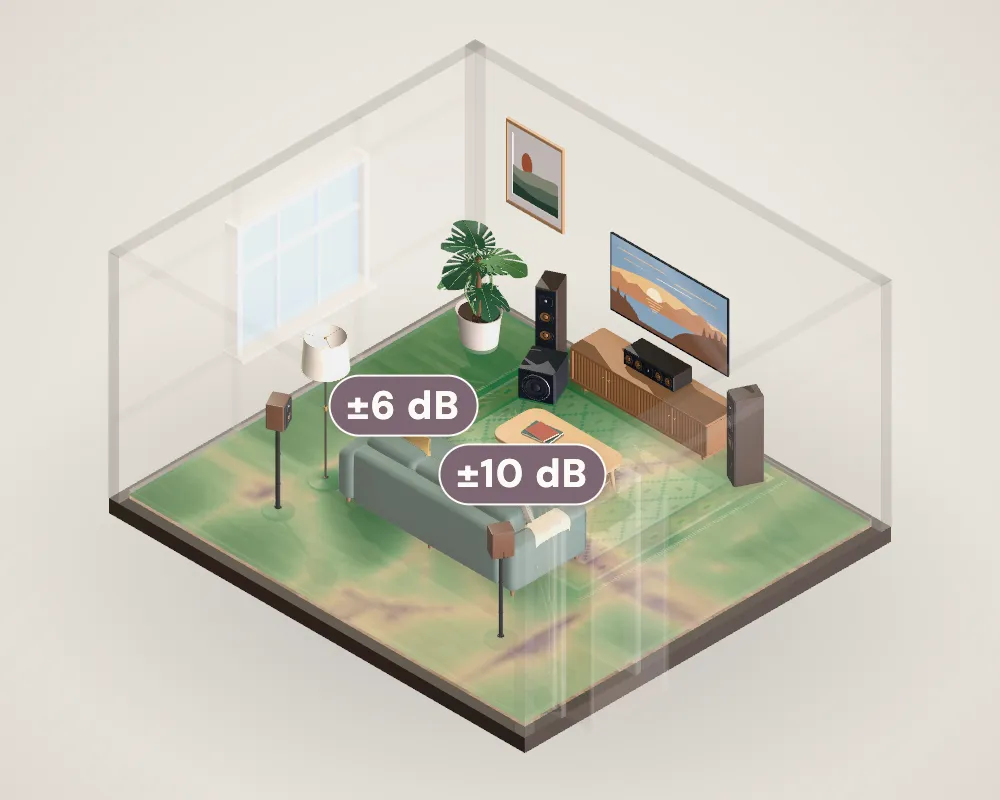
- Two subwoofers work: on opposite walls they cut the seat-to-seat difference by 32%.
- The viewing-distance rules mostly agree with the standards; the 4/6/8 and 3-5-7 rules aren’t about home theater.
Simulated rectangular rooms: they show which way the odds point, and every finding held when we changed the model’s assumptions (the check).
Where to sit: the 38% rule and its rivals
For each of 1,000 random rooms, we placed a subwoofer at the front, then moved a seat along the room’s center line from 15% to 85% of the way back, and measured how even the bass was at each position from 25 to 120 Hz. Then we asked: where does each rule’s seat rank among those 71 positions?
Median percentile among 71 seat positions (shorter is better; dashed line = the middle, 50th percentile)
38% from the front wall ranked in the better half in both setups. 38% from the back wall (62% of the way back) did badly in both, even though the rule treats it as equivalent. The reason is the subwoofer: room modes are symmetrical, but with the sub at the front, the odd-numbered modes arrive at those two spots with opposite polarity, so they add up differently. The rule’s symmetry only holds if the source is too.
Against the back wall was the most even position of all, with no deep cancellations, but it got about 3.7 to 4.3 dB more bass than the average position along the room. That extra level is what people usually mean by boomy bass: heavy rather than missing notes. (Our score measures evenness and level, not how long the bass rings, so this is the louder half of “boomy”.) The best position varied a lot from room to room: with a corner sub, the most even seat was a median 27% of the way back, and in half the rooms between 23% and 78%.
Try it in your own roomThe subwoofer simulator uses the same model: move the seat and the sub and watch the bass change. Open →Room proportions: golden ratios and “ideal” rooms
We rebuilt every room at the same volume with each famous set of proportions (height : width : length) and averaged the bass evenness over 16 seats in the middle of the room, with a corner subwoofer. Random rooms averaged 6.94 on this score, with the middle 80% between 6.57 and 7.33.
Bass evenness compared with a random room of the same volume (dB; left of center = better)
The “ideal” ratios were within a quarter of a decibel of a random room, smaller than the variation between random rooms and a tenth of the effect of where you sit. The golden ratio did no better than chance. What clearly does matter is avoiding cubes and double squares, where room modes stack on the same frequencies. Sepmeyer, whose ratios are among the most quoted, said himself that no clearly defined optimum emerged from his calculations.
One subwoofer or two
| Setup | Seat-to-seat variation | Evenness at each seat |
|---|---|---|
| One sub, front corner | 4.51 dB | 7.31 |
| One sub, front-wall center | 3.74 dB | 7.92 |
| Two subs, front and back wall centers | 3.07 dB | 7.42 |
| Two subs, side wall centers | 3.18 dB | 9.63 |
Two subs on opposite walls made the bass far more consistent from seat to seat (32% less variation than a corner sub) while keeping each seat about as even as the best single position. That matches Harman’s 2006 research (Welti and Devantier), which found two well-placed subs nearly as effective as four. Side-wall pairs evened out the seats too, but made the response at each seat less even in our model.
The viewing and speaker rules: checked against the standards
| Rule | What it works out to | Compared with |
|---|---|---|
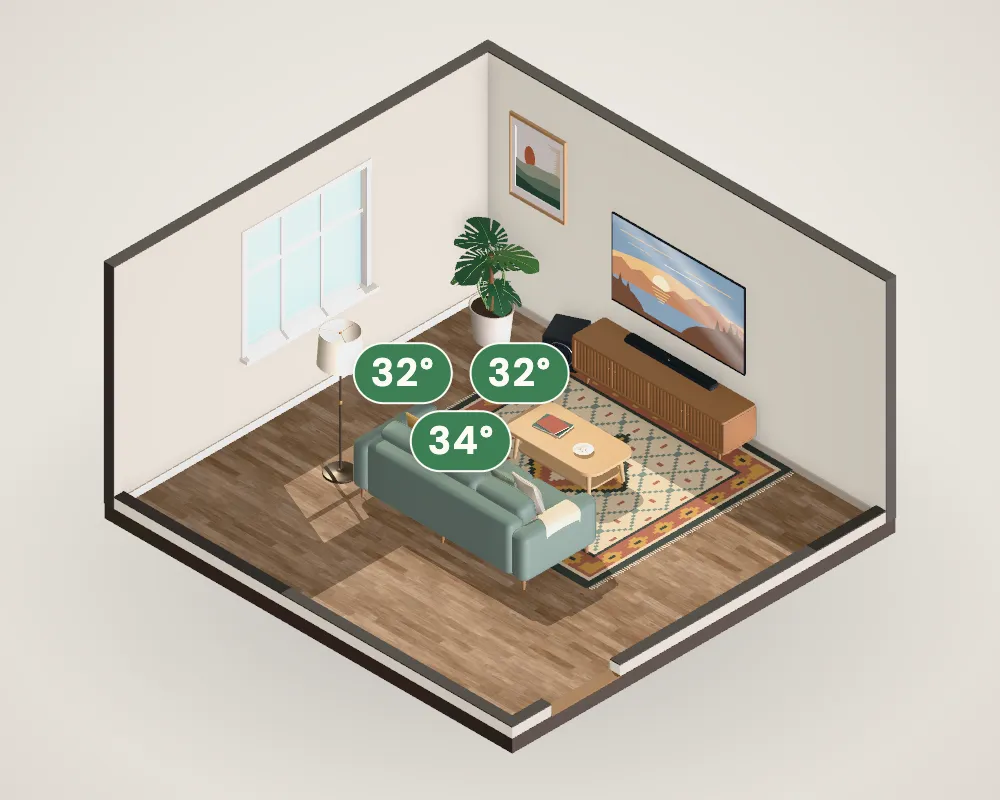
| Sit 1.5 × the diagonal away | 32° view | SMPTE reference distance: 31–33° |
| Sit 2 × the diagonal away | 25° view | Below the 30° that most guidance treats as the low end |
| Samsung: diagonal ÷ 0.55 | 27° view | Relaxed TV watching |
| Samsung (buying guide): diagonal × 1.2 | 40° view | THX’s 40° cinema angle |
| Sony 4K minimum: 1.5 × picture height | 61° view | The 61° maximum for 4K cited in CEDIA/CTA RP22; Sony calls it a minimum |
| The 83% rule (speaker spacing) | 49° between speakers | Dolby: 44–60° for front left and right |
| Equilateral triangle | 60° between speakers | ITU-R BS.1116 stereo reference; top of Dolby’s range |
| 4/6/8 × image height (farthest viewer) | 25° / 17° / 13° | Meeting-room legibility, not cinema immersion |
The scorecard: every rule we checked
- Half trueThe 38% ruleSit 38% of the room’s length from the front or back wall.Practitioner rule (Ethan Winer, RealTraps); origin not established
38% from the front ranked in the better half of seat positions (median 39th percentile, corner sub). 38% from the back was among the worst (82nd).
- Mostly holdsRule of fifths (seat)Seat one-fifth of the room’s length from the back wall.Hi-fi rule of thumb (PS Audio); several variants
Better than average: 42nd percentile with a corner sub, 20th with a front-wall sub.
- PartlyDon’t sit in the middleThe center of the room is a bass dead spot.Room-mode physics (first length mode)
With a corner sub, the middle was slightly worse than average (55th percentile) and 1 dB down on bass; with a front-wall sub, slightly better than average.
- True, differentlyKeep the sofa off the back wallBass builds up at the back wall.CEDIA/CTA RP22; boundary physics
Against the back wall bass was the most even, but about 3.7–4.3 dB louder than the average position along the room: heavy, not hollow.
- MythGolden-ratio roomA room proportioned 1 : 1.618 : 2.618 has the best bass.Audio folklore (golden cuboid)
Bass at the seats was no better than in a random room of the same volume (difference 0.00 dB).
- Small effectSepmeyer, Louden & Bolt ratiosPublished “ideal” room ratios smooth the bass.Acoustics papers (1946–1971); Sepmeyer found no clear optimum
Slightly better than random rooms (up to 0.25 dB), far less than the effect of where you sit. Cubes (1.9 dB worse) and double squares (0.5 dB worse) really are bad.
- HoldsTwo subs beat oneTwo subwoofers even out bass across seats.Welti & Devantier (Harman), 2006
Two subs on opposite walls cut seat-to-seat variation by 32% compared with one sub in a corner.
Show the 7 viewing-distance, speaker and decorating rules
- Holds (low end)Sit 1.5× the diagonal awaySeating distance = 1.5 × screen size.HD-era retail rule (CNET quoted 1.5–2×)
1.5× gives a 32° view, right on SMPTE’s reference (31–33°). 2× gives 25°, small for 4K.
- RelaxedSamsung: diagonal ÷ 0.55Viewing distance = diagonal ÷ 0.55.Samsung US support
Gives a 27° view: comfortable for TV, a little small for films.
- HoldsThe 83% ruleSpeaker spacing = 0.83 × your distance to each speaker.Jim Smith, Get Better Sound
Works out to a 49° angle between the speakers, inside Dolby’s 44–60° for front left and right.
- HoldsEquilateral triangleSpeakers and listener form an equilateral triangle.ITU-R BS.1116 stereo reference (60°)
A 60° pair: the reference for stereo listening rooms and the top of Dolby’s range for home theater fronts.
- Wrong roomThe 4/6/8 ruleFarthest viewer at 4, 6 or 8 × the image height.Meeting-room display sizing (AVIXA-style legibility)
For reading content in meetings, not films: 4× height is a 25° view, 8× just 13°.
- Not about TVsThe 3-5-7 ruleGroup things in threes, fives and sevens.Decorating folklore
A styling rule for arranging objects; nothing to do with screens or sound.
- Styling onlyThe two-thirds sofa ruleSofa about two-thirds the width of the wall or rug.Interior-design proportion cue
A visual proportion, not a viewing or sound rule. Viewing distance and side-seat angles matter more.
How we tested
- Rooms: 1,000 rectangular rooms with random dimensions: length 12–26 ft (front to back), width 10–20 ft (never wider than long), ceiling 7.5–10 ft. Seeded (seed 20261004), so the published code gives the same numbers every time. For the room-ratio test, each room was rebuilt at its own volume with each set of proportions, so ceiling height and seat positions scale with it.
- Model: the standard modal model of a rectangular room with rigid walls (Kuttruff, Room Acoustics), summing every mode below 250 Hz with damping from a 0.5-second low-frequency decay time, plus the room’s pressure-chamber term. It’s the same model code as our subwoofer simulator, which sums modes to 320 Hz; the check below shows that makes no difference.
- Positions: ears at 1.2 m (Dolby’s seated ear height); subwoofer drivers at 0.3 m, 0.3 m from the walls.
- Score: the standard deviation of the level at the seat across 48 frequencies from 25 to 120 Hz. Lower means more even bass. It measures evenness, not loudness, which is why we report bass level separately for the back-wall seat.
Does it depend on our assumptions?
We reran the whole study changing one assumption at a time. The findings kept their direction and roughly their size in every run.
| Run | 38% from front | 38% from back | Golden vs random | Cube vs random | Two subs | Back-wall bass |
|---|---|---|---|---|---|---|
| Published run (0.5 s decay, ears 1.2 m, sub 0.3 m up, modes to 250 Hz, 48 frequencies) | 39th | 82nd | 0.00 dB | +1.9 dB | −32% | +3.7 dB |
| Livelier room: 0.7 s bass decay | 39th | 83rd | +0.15 dB | +1.9 dB | −35% | +4.1 dB |
| Deader room: 0.35 s bass decay | 39th | 79th | −0.11 dB | +1.7 dB | −28% | +3.1 dB |
| Lower ears: 1.0 m (deep sofa) | 39th | 83rd | +0.01 dB | +2.0 dB | −30% | +3.6 dB |
| Sub driver higher: 0.5 m | 39th | 82nd | −0.02 dB | +1.8 dB | −32% | +3.8 dB |
| Modes to 320 Hz (the simulator’s setting) | 39th | 82nd | −0.01 dB | +1.9 dB | −33% | +3.7 dB |
| Twice as many frequencies (96) | 39th | 82nd | 0.00 dB | +1.9 dB | −32% | +3.7 dB |
Data and code: summary results (JSON, with the sensitivity runs), every room’s results (JSON, 0.9 MB), and the code that produced them: the study script and the room model (TypeScript). Data generated 2026-10-05. You’re welcome to cite or republish them under CC BY 4.0 with a link to this page.
Questions people ask
Does the 38% rule work?
Partly. In our simulation, sitting 38% of the room’s length from the front wall gave more even bass than most positions, but 38% from the back wall (which the rule also allows) was one of the worst when the subwoofer was at the front. Treat it as a starting point, then listen or measure.
Do golden-ratio rooms sound better?
Not in our simulation. Rooms with golden-ratio proportions had bass no more even than random rooms of the same volume. Avoiding cubes and rooms whose dimensions are simple multiples of each other matters; the exact “ideal” ratio barely does.
Is it worth having two subwoofers?
For more than one seat, yes. Two subs on opposite walls reduced seat-to-seat bass variation by 32% compared with one sub in a corner, in line with Harman’s research.
Can I use this data?
Yes. The results are free to cite under CC BY 4.0 with a link to this page. The summary, every room’s results and the code are linked under “How we tested”.
Sources
- RealTraps (Ethan Winer). How to set up a room: the 38 percent rule.Rule of thumb
- Audioholics forum. The 38% Rule (forum thread, Ethan Winer).Rule of thumb
- PS Audio (Copper) (2021). Superposition: getting speaker placement right.Rule of thumb
- The Absolute Sound (2022). The magic formula for perfect speaker set-up?! (Jim Smith interview).Rule of thumb
- ITU-R (2015). Recommendation ITU-R BS.1116-3: Methods for the subjective assessment of small impairments in audio systems.Standard
- Dolby Laboratories (2018). Dolby Atmos Home Theater Installation Guidelines, r3.1.Manufacturer
- CNET (2012). TV buying guide: size up your screen (archived).Rule of thumb
- Samsung US Support. Where to mount the TV.Manufacturer
- Sony Electronics Support (2025). Recommended viewing distance for watching TV.Manufacturer
- SMPTE (2017). ST 2080-3:2017 Reference Viewing Environment for Evaluation of HDTV Images.Standard
- THX. Viewing Guide FAQ.Professional guide
- AVIXA. Display image size for 2D content (DISCAS) and display-size guidance.Standard
- Homes & Gardens (2025). The 3-5-7 styling method.Rule of thumb
- Livingetc (2025). The two-thirds rule for living rooms.Rule of thumb
- Cardas Audio. Speaker placement guide: the golden cuboid.Rule of thumb
- Journal of the Acoustical Society of America 37 (1965). Computed frequency and angular distribution of the normal modes of vibration in rectangular rooms (Sepmeyer).Research
- Journal of the Audio Engineering Society / Harman (2006). Low-Frequency Optimization Using Multiple Subwoofers (Welti & Devantier).Research
- CEDIA / CTA (2023). CEDIA/CTA-RP22 Immersive Audio Design Recommended Practice, v1.2.Standard
- Room EQ Wizard. Room Simulation (modal simulator) help.Professional guide
- Journal of the Acoustical Society of America (1979). Image method for efficiently simulating small-room acoustics (Allen & Berkley).Research
Numbers on this page follow these sources. Where a figure is our own calculation or a rule of thumb, the text says so. Found a mistake? Tell us.