Subwoofer placement and the subwoofer crawl
Where a subwoofer sits changes the bass at your seat more than almost anything else you can buy. The good news: finding the right spot is free.
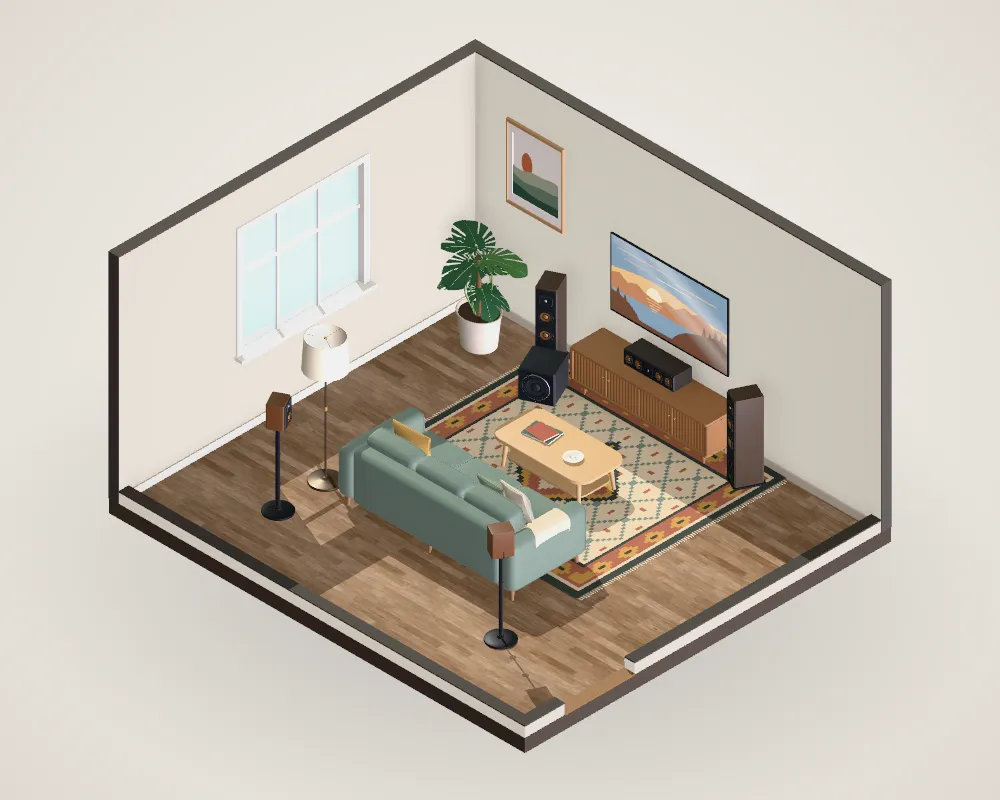
Start with the subwoofer along the front wall or in a front corner: SVS and Klipsch both suggest a corner for maximum output. Then do the subwoofer crawl: put the sub on your main seat, play a bass-heavy track, and crawl around the possible positions with your head near the floor; wherever the bass sounds most even and full, put the sub there. Corners give the most output but can exaggerate booms and dips. Avoid sitting in the exact middle of the room, where bass often drops out, and if you can, two subs on opposite walls even out bass across seats far better than one.
Why placement matters so much for bass
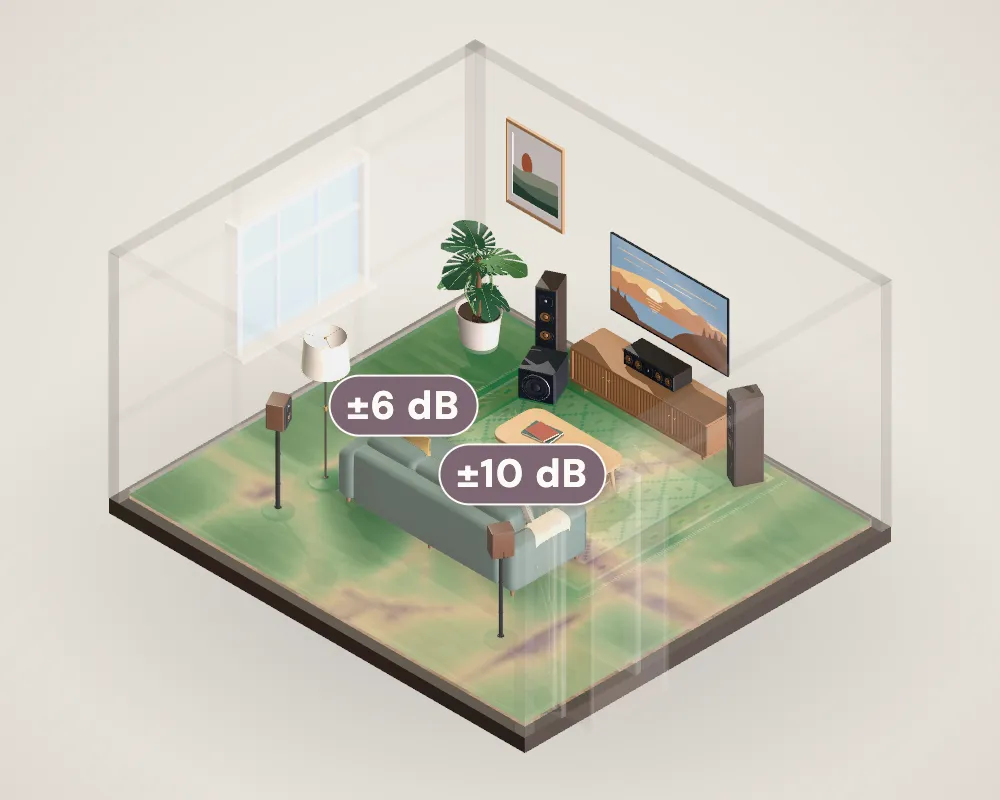
At low frequencies, sound waves are as long as your room: about 11 feet at 100 Hz and 23 feet at 50 Hz. They bounce between the walls and pile up into room modes, standing patterns where some spots get far too much bass and others almost none. Move your head two feet and a bass note can go from booming to thin.
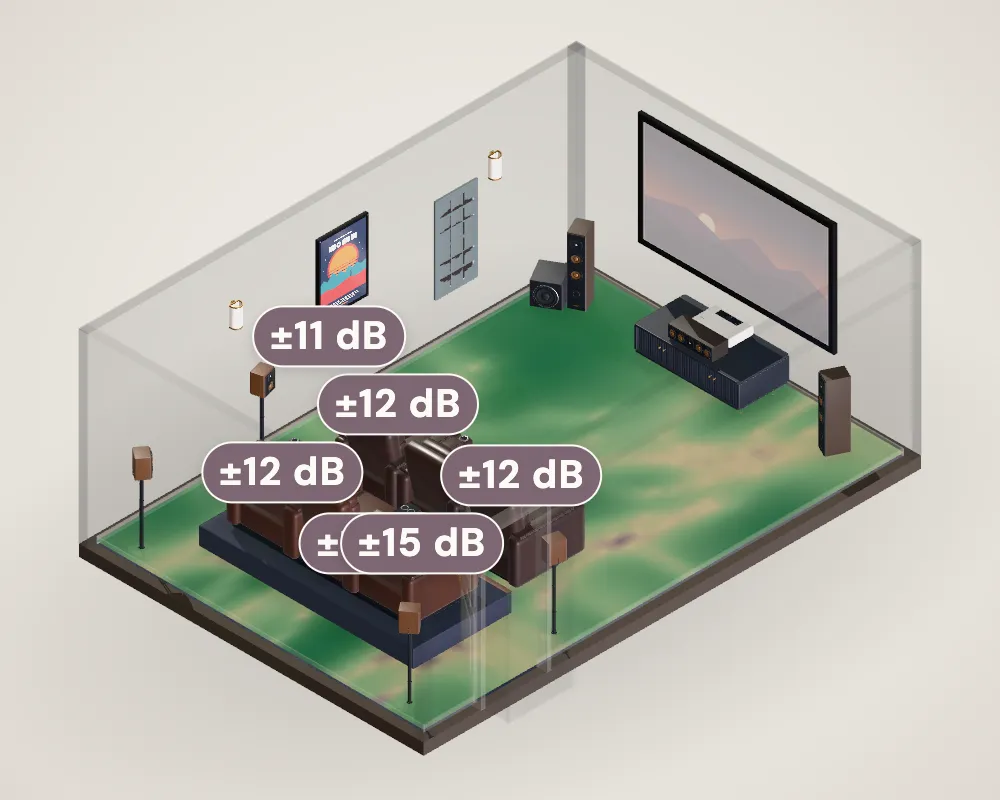
Two positions decide what you hear: where the subwoofer is, and where you sit. Changing either changes which modes get excited and which you sit in. That’s why the same subwoofer can sound tight in one corner and boomy in another, and why no rule can tell you the best spot for every room.
Subwoofer placement simulatorA virtual sub crawl: map how smooth the bass at your seat would be for every sub position in your room. Open →Step 1: pick a starting point
Manufacturers mostly agree on where to start, and disagree a little on why:
| Maker | Starting advice |
|---|---|
| SVS | Try a corner first, then experiment; corners can exaggerate peaks and dips |
| Klipsch | A corner on the front-speaker wall gives the most output; mid-wall or out in the room gives less |
| Bose (Bass Module 500) | On the TV wall or in the front third of the room, at least 3 inches from other surfaces; closer to walls and corners gives more bass |
| KEF | About a third or a fifth of the room away from a wall; if it has to go against a wall, avoid the corners |
| Sonos (Sub 4) | Corner, against a wall, or behind, beside or under furniture; leave at least an inch above it if it lies flat under something |
Corners give the most output because each boundary reinforces the bass. Genelec’s idealized figures are up to +6 dB with one wall, +12 dB where a wall meets the floor, and +18 dB in a corner, compared with a speaker in free space. In a real, furnished room the boost is smaller and uneven, which is the catch: a corner also excites every room mode at once, so some notes boom.
A front position also helps the sub blend with the main speakers, so bass seems to come from the screen rather than from behind you.
Step 2: the subwoofer crawl
The subwoofer crawl uses a simple fact of physics: sound travels the same way in both directions between two points. So instead of moving a heavy sub around and running back to the sofa each time, you swap places.
- Put the sub on your main seat, or on the floor right in front of it.
- Play steady, repetitive bass: a bass-heavy music track or a film scene you know well. A test tone sweep works too, but music is easier to judge.
- Get down on the floor and crawl slowly around the area where the sub could go: along the front wall, into the corners, beside the TV console. Keep your head near the height of the sub’s driver.
- Listen for evenness, not loudness. You want the spot where the bass notes sound equally strong, without one booming and another vanishing.
- Mark the best spot, put the sub there, and listen from the seat to confirm.
Step 3: check the seat too
The crawl finds the best place for the sub; the seat matters just as much. In our 1,000-room simulation, moving the seat along the room changed how even the bass was by about as much as moving the sub. A few positions are worth knowing about:
- Right against the back wall. Bass builds up at walls: in our simulation, a head against the back wall got about 4 dB more bass than the room average. It’s even, but heavy, which is what people hear as boom. CEDIA/CTA RP22 recommends keeping listeners off the back wall where possible.
- The exact middle of the room. The first length mode has a dead spot halfway between the front and back walls, so the lowest notes can thin out there.
- About 62% of the way back (38% from the back wall). With the sub at the front, this was one of the least even positions in our simulation, even though the popular “38% rule” says it should be as good as 38% from the front.
The “38% rule” itself (sit about 38% of the room’s length from the front wall) did better than average in our simulation, but it’s a starting point for listening, not a guarantee.
Step 4: dial in the settings
Once it’s placed, a few settings make a real difference:
- Run your receiver’s room calibration. SVS recommends setting the sub’s phase to 0 and its low-pass filter to its highest setting (or off) first, so the receiver can manage the crossover.
- Phase. If your sub has a 0/180° switch, Klipsch’s advice is to pick whichever gives more bass at your seat. Sonos sets it automatically with Trueplay.
- Level. Set it so bass sounds balanced with the speakers, not as loud as possible. Room calibration usually gets close.
When two subwoofers are better than one
If several people watch, one sub can only optimize one seat. Harman’s Todd Welti and Allan Devantier studied this in detail: well-placed multiple subs cut the difference in bass from seat to seat dramatically, and two subs at the midpoints of opposite walls were nearly as effective as four. Four did best overall, at the cost of more boxes in the room. In their measured rooms, optimized multi-sub setups also gained 3 to 6 dB of maximum output.
CEDIA/CTA RP22 sets targets for how much bass may vary from the main seat to the others: within ±4 dB at its Level 2, tighter at higher levels. A single sub rarely meets those in a multi-row room; two usually can.
Subwoofers in apartments
Bass travels through floors and walls far more readily than higher sounds. KEF’s advice for apartments:
- Avoid corners: the extra output carries next door.
- Keep the sub away from shared walls, ideally against an outside wall or near a structural column.
- Move it closer to your seat: it needs less total output to sound full where you are.
- Isolation feet help a little: KEF says they reduce transmission by a decibel or less. Some subs, like KEF’s KC62, have an apartment mode that cuts the deepest bass.
Questions people ask
Where is the best place to put a subwoofer?
There’s no single best spot because every room is different. Start along the front wall or in a front corner (a corner gives the most output), then use the subwoofer crawl to find the position where bass sounds most even at your seat.
How do you do a subwoofer crawl?
Put the subwoofer on your main seat (or as close to your listening position as you can). Play music or a film scene with steady, repeating bass. Get down on the floor and crawl around the places the sub could go, with your head near the height of the sub’s driver. Where the bass sounds smoothest and fullest, mark the spot and put the sub there. It works because sound travels the same way in both directions between two points.
Should a subwoofer be in a corner?
A corner gives the most output, because the walls and floor reinforce the bass (Genelec’s idealized figure is up to 18 dB from three boundaries). But it also excites every room resonance, which can make some notes boom. Try the corner, then compare with spots along the front wall.
Can I put a subwoofer behind the couch?
Yes, near the listening position works well in many rooms, and KEF suggests it for apartments because the sub needs less total output to sound full at the seat. Check the sub maker’s clearance rules (Bose asks for at least 3 inches from surfaces) and blend it with the front speakers using the phase and distance settings.
Do subwoofer isolation pads stop bass going through the floor?
Not much. KEF says isolation feet reduce transmission by a decibel or less, and we found no published measurements of how much they help the neighbors. Most bass travels through the air and the building structure; placement and level matter more.
Is it better to have two subwoofers?
Usually, if your goal is even bass across several seats. Harman’s Welti and Devantier found two well-placed subs nearly as effective as four at reducing seat-to-seat variation. Two subs at the midpoints of opposite walls is a good starting point.
Sources
- SVS. The Art of Subwoofer Placement.Manufacturer
- Klipsch (2018). Reference Subwoofers owner’s manual (2018, v02).Manufacturer
- KEF (2025). Phase and positioning: where to place a subwoofer.Manufacturer
- KEF. Subwoofer Setup Tips For Apartment Living.Manufacturer
- KEF (2020). KC62 subwoofer user manual.Manufacturer
- Bose (2021). Bass Module 500 owner’s guide.Manufacturer
- Sonos. Sub 4 user guide: select a location.Manufacturer
- Genelec. How to place your monitors.Manufacturer
- SVS (2020). What is subwoofer room gain?.Manufacturer
- SVS (2020). Subwoofer calibration and tuning: getting the bass just right.Manufacturer
- Journal of the Audio Engineering Society / Harman (2006). Low-Frequency Optimization Using Multiple Subwoofers (Welti & Devantier).Research
- CEDIA / CTA (2023). CEDIA/CTA-RP22 Immersive Audio Design Recommended Practice, v1.2.Standard
- Room EQ Wizard. Room Simulation (modal simulator) help.Professional guide
- Journal of the Audio Engineering Society / Harman (2006). Loudspeakers and Rooms for Sound Reproduction — A Scientific Review (Toole).Research
Numbers on this page follow these sources. Where a figure is our own calculation or a rule of thumb, the text says so. Found a mistake? Tell us.