Apartment home theater: great sound, fewer complaints from the neighbors
Through a wall, the neighbors mostly hear your bass, not your dialogue. Plan around that and an apartment can sound great without making you the loud flat.
Bass is the problem: it passes through walls and floors far more easily than voices. Keep the subwoofer out of corners and away from shared walls, move it closer to your seat so it needs less output, and use apartment or night modes that cut the deepest bass (KEF). Isolation feet help a decibel or less. A soundbar or 3.1/5.1 system at moderate volume, with rugs on hard floors, is usually the right balance. Building codes require walls and floors between units of about STC/IIC 50, but those ratings don’t cover bass from a home theater.
Why bass is the problem
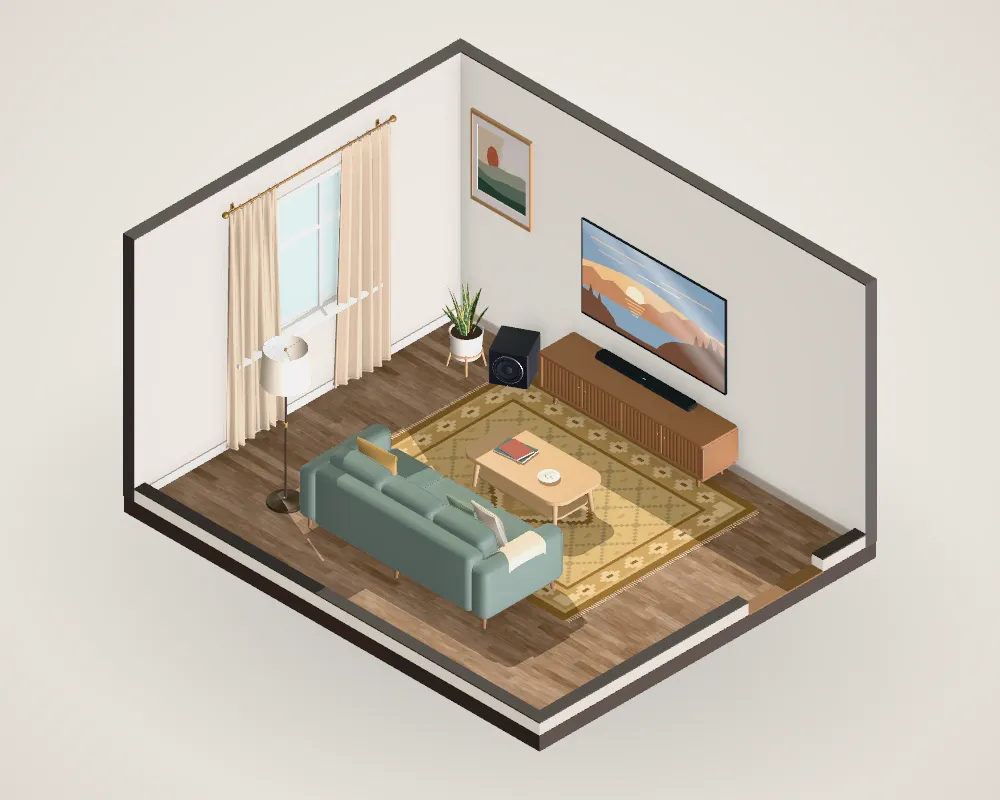
Walls and floors stop high frequencies far better than low ones. Your dialogue may be inaudible next door while the subwoofer comes through clearly, as anyone who has lived under a party knows. That shapes every choice below.
What building codes guarantee (and don’t)
The International Building Code, adopted in most US jurisdictions, requires walls and floors between dwelling units to reach STC 50 (airborne sound) and IIC 50 (impact sound) in lab tests, or NNIC 45 and NISR 45, the matching field ratings, when tested in the building (2021 edition; the edition and amendments your city adopted govern). Two caveats matter for home theater:
- The ratings aren’t built for bass. ASTM’s rating standard says single-number ratings aren’t appropriate for sounds like many music systems, and the impact rating doesn’t cover anything below 100 Hz.
- Real buildings vary. A Canadian survey of 300 pairs of homes measured party walls from STC 38 to 60, with an average of about 50, including sound leaking around the wall.
So “code-compliant” doesn’t mean “subwoofer-proof”.
Subwoofer placement for apartments
KEF’s advice for apartment living:
- Avoid corners. They maximize bass output, which is what carries next door.
- Stay away from shared walls and floors. Put the sub against an outside wall or near a structural column if you can, angled away from the neighbors’ side.
- Move it near your seat. Close to your ears, it needs less output to sound full where you are, so less reaches the neighbors.
- Use apartment or night modes. Some subs, like KEF’s KC62, have an apartment mode that trims the deepest bass; many receivers and soundbars have night modes.
- Don’t count on isolation feet. KEF says they reduce transmission by a decibel or less.
The rest of the system
- A soundbar is the low-friction choice: no speakers on stands, nothing in the corners. Follow its gap rules; see soundbar placement.
- 3.1 or 5.1 works well at moderate volumes; a dedicated center speaker keeps dialogue clear without turning everything up.
- Rugs on hard floors cut footfall noise for the people below and calm reflections in your room. Many leases require them: one large landlord’s handbook asks for rugs over at least 75% of hard floors outside kitchens and baths.
Questions people ask
Can I have a subwoofer in an apartment?
Yes, with care. Keep it out of corners and away from shared walls and floors, move it near your seat, keep the level modest and use an apartment or night mode if it has one. Check your lease for noise rules.
Do subwoofer isolation pads work in apartments?
They reduce vibration into the floor a little: KEF says isolation feet cut transmission by a decibel or less. Makers of pads claim more, but we found no published measurements of how much they help the people next door.
How soundproof are apartment walls?
Building codes based on the International Building Code require walls and floors between units rated STC 50 and IIC 50 in lab tests, or NNIC 45 and NISR 45 when tested in the building (the 2021 edition’s field ratings; your local code may differ). A Canadian survey of 300 home pairs measured walls from STC 38 to 60, averaging about 50. These ratings describe speech and footsteps; ASTM notes they don’t suit music, and impact ratings don’t cover sound below 100 Hz.
Sources
- KEF. Subwoofer Setup Tips For Apartment Living.Manufacturer
- KEF (2020). KC62 subwoofer user manual.Manufacturer
- International Code Council (2021). International Building Code 2021, §1206: sound transmission.Standard
- ASTM International (2022). ASTM E413-22: classification for rating sound insulation.Standard
- ASTM International (2021). ASTM E989-21: impact sound rating.Standard
- National Research Council Canada (2001). Acceptable party wall sound insulation criteria (Bradley), Canadian Acoustics 29(3).Research
- Equity Residential (2020). Resident handbook (noise and floor coverings).Professional guide
- Sonos. Sonos Arc Ultra user guide (placement).Manufacturer
- CEDIA / CTA (2023). CEDIA/CTA-RP22 Immersive Audio Design Recommended Practice, v1.2.Standard
Numbers on this page follow these sources. Where a figure is our own calculation or a rule of thumb, the text says so. Found a mistake? Tell us.