How to reduce echo in a room
An echoey room makes dialogue harder to follow and turns the volume up. The fixes are cheap if you do them in the right order.
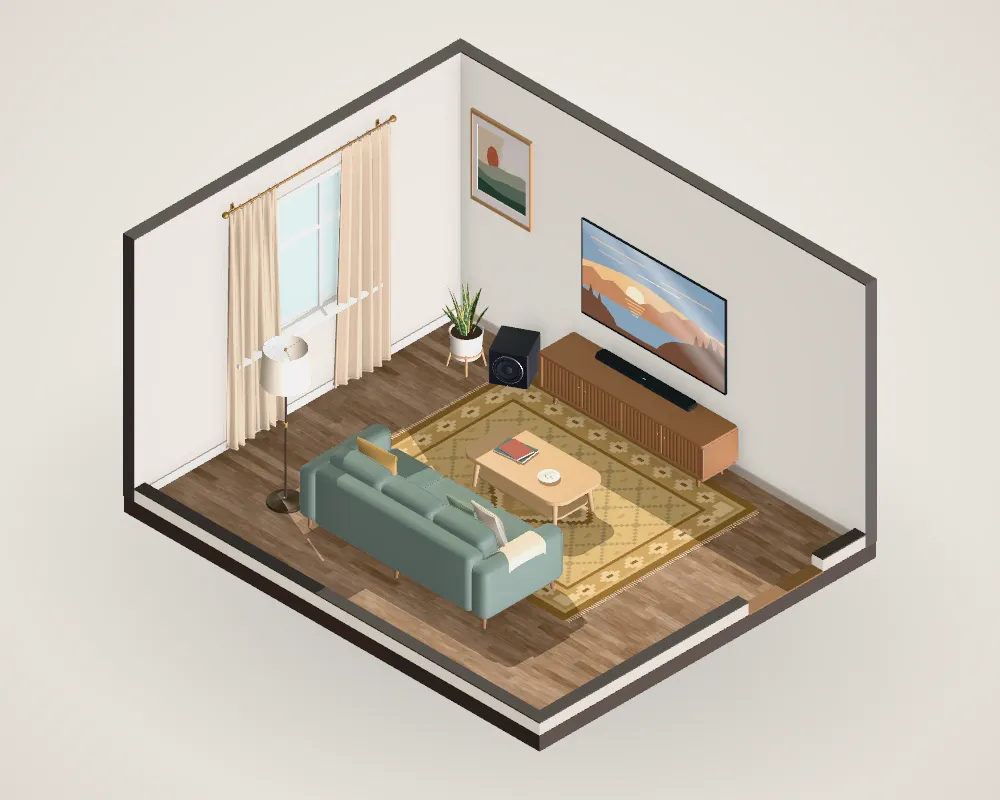
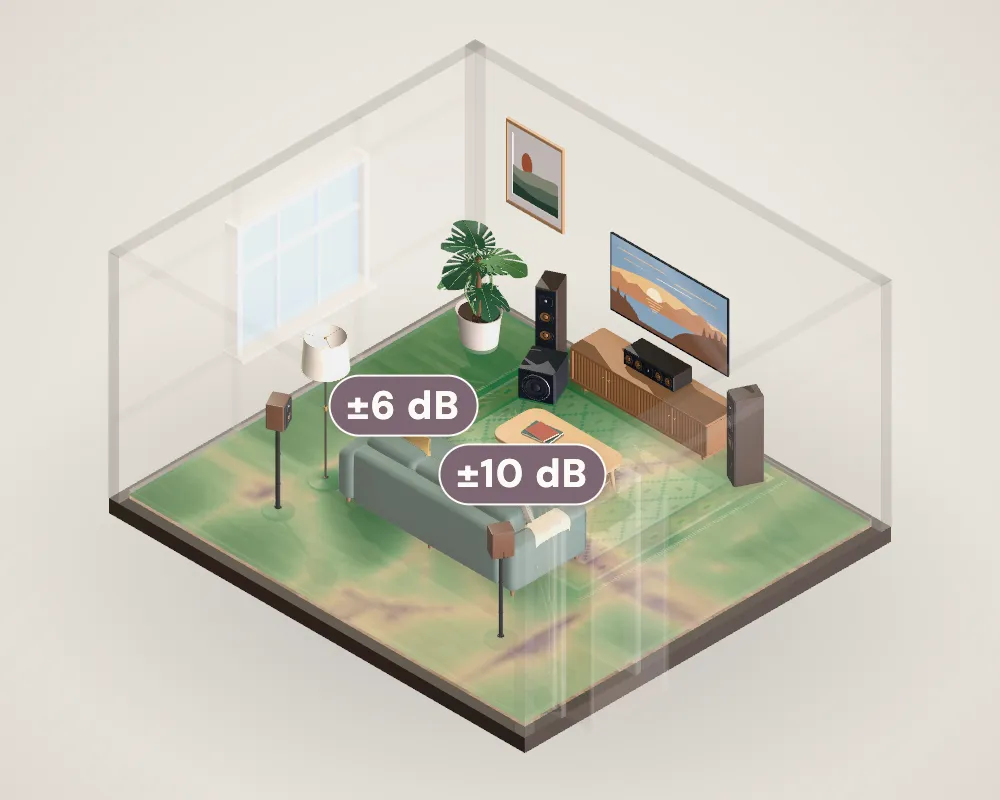
Echo comes from sound bouncing between hard, bare surfaces, so add soft, thick material where sound bounces most. In order: furnish (an upholstered sofa absorbs a lot), lay a large rug, hang heavy curtains with plenty of fullness, then put acoustic panels at the first-reflection points on the side walls. Thickness matters: a 2-inch panel works on voices and treble but barely touches bass; 4 inches or more works across most of the range. For flutter echo (a ringing between two parallel walls), treat one of the two facing surfaces.
What “echo” is in a living room
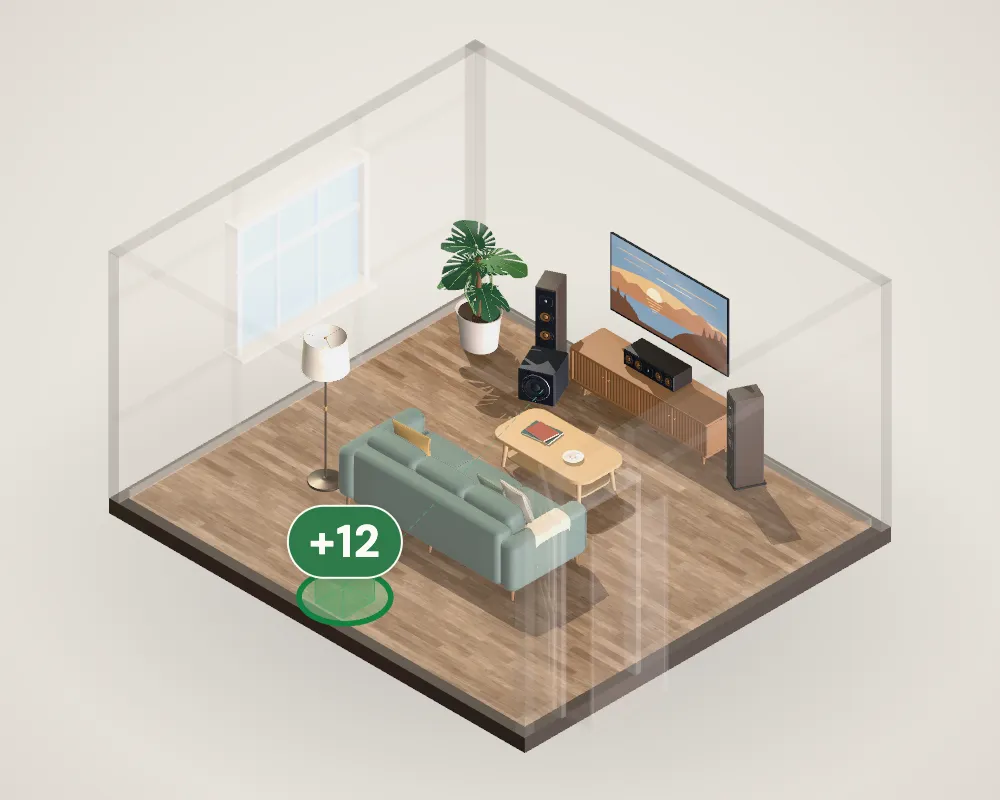
In a big hall, echo is a distinct repeat. In a living room it’s usually two related things:
- Too much reverberation: sound keeps bouncing around after it should have died away, so dialogue blurs and you turn the volume up.
- Flutter echo: a fast, metallic ringing between two hard parallel surfaces, easy to hear if you clap in an empty room.
Both come from hard, bare surfaces: drywall, glass, wood or tile floors, bare ceilings. Both are fixed by adding material that absorbs or scatters sound.
How much is enough?
Listening-room standards express it as decay time: how long sound takes to fade. CEDIA/CTA RP22, the residential home-theater recommended practice, targets about 0.3 seconds for a 100 m³ room (about 3,500 cubic feet, say 20 × 18 × 10 ft), a little less in smaller rooms: about 0.23 seconds for a 15 × 13 × 8 ft living room. Its long-standing guideline range is 0.2–0.5 seconds. A bare, hard living room is often well above that; a furnished one with a rug and curtains often lands near it.
Panel makers express it as coverage instead: Primacoustic suggests treating 15–25% of the wall area as a starting point (25% or more for theaters), and Acoustimac 25–30% of all hard surfaces. They measure different things, so don’t compare the percentages directly; both mean “a meaningful fraction, not one panel.”
Fix it in this order
1. Furniture. Upholstered seating is a big absorber. A lab test of one two-seat sofa (Offecct’s Lucy) measured about 3.5 square meters of absorption at mid frequencies, the same as 3.5 m² of a perfect absorber. A bare room with a sofa, armchairs and a full bookshelf sounds very different from an empty one.
2. A large rug. Rugs absorb mid and high frequencies and stop the floor–ceiling flutter. Go thick and add a pad. They do little for bass: a tested carpet tile absorbed 2% of sound at 125 Hz but 47% at 500 Hz.
3. Heavy curtains, with fullness. Curtains are surprisingly variable. One acoustic curtain hung flat 150 mm from the wall absorbed about 72% at 500 Hz; the same fabric hung with 100% fullness (twice its width in fabric) absorbed 89%. A light curtain with the same fullness absorbed only about 10% across most of the range. Heavy fabric, generous pleats and a gap from the window all help.
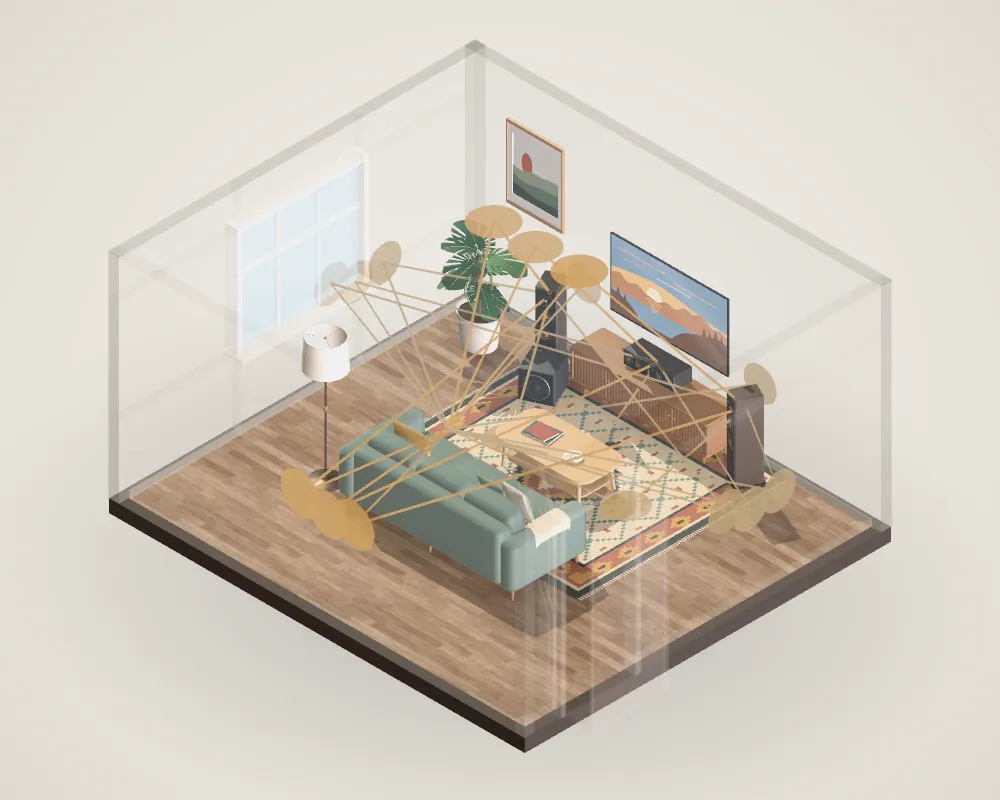
4. Acoustic panels at the reflection points. The most effective single places for panels are the first-reflection points on the side walls, where sound from your front speakers bounces once on its way to you. Find them with the mirror trick or our panel placement finder. Then the ceiling between the speakers and the seats, and the wall behind the seats.
Thickness matters more than looks
Thin treatment absorbs treble and leaves bass untouched, which can make a room sound dull rather than controlled:
| Material (lab-tested) | 125 Hz | 500 Hz | 2 kHz |
|---|---|---|---|
| 2-in foam panel (Auralex SonoFlat) | 0.21 | 1.05 | 1.15 |
| 3-in foam panel (Auralex SonoLite) | 0.55 | 1.25 | 1.18 |
| 2-in mineral wool board (ROCKWOOL ROCKBOARD 60) | 0.26 | 1.12 | 1.03 |
| 4-in mineral wool board (ROCKWOOL ROCKBOARD 60) | 1.03 | 1.12 | 1.07 |
Absorption coefficients from each maker’s lab reports; values above 1.0 are an artefact of the test method, not more than 100% absorption.
GIK Acoustics recommends 2 inches as a minimum for speech and 4 inches or more for music and cinema, with an air gap behind the panel extending its reach into the bass.
Flutter echo
Stand between two bare parallel walls and clap: a fast “zing” is flutter echo. You don’t need to treat both walls. Put absorption or a diffuser (a panel with an irregular surface that scatters sound) on one of the two, at about head height, and clap again. GIK and Acoustimac both point to the offending parallel surfaces as the place to start, rather than any fixed amount of treatment.
See where your room ringsRoom Studio's acoustics view estimates decay and reflections for your room, then suggests the next best fix. Open Room Studio →Questions people ask
What is the cheapest way to reduce echo in a room?
Soft furnishings you may already want: a large rug, heavy curtains, an upholstered sofa and a full bookshelf. They won’t fix bass, but they take the harsh ring out of a bare room. Acoustic panels at the side-wall reflection points are the next step.
Do rugs reduce echo?
Yes, at mid and high frequencies, especially thick rugs with a pad. They do almost nothing for bass: a measured carpet tile absorbed just 2% of sound at 125 Hz. We found no published lab test of a typical area rug and pad.
Does foam reduce echo?
Yes. A 2-inch Auralex foam panel tested at Riverbank Labs absorbed about 21% of sound at 125 Hz and essentially all of it from 500 Hz up. Thin foam works on voices and treble but isn’t bass treatment.
What causes flutter echo?
Sound bouncing back and forth between two hard, parallel surfaces, such as bare opposite walls, producing a fast ringing after a clap. Absorption or diffusion on one of the two surfaces breaks it up.
Sources
- CEDIA / CTA (2023). CEDIA/CTA-RP22 Immersive Audio Design Recommended Practice, v1.2.Standard
- ITU-R (2015). Recommendation ITU-R BS.1116-3: Methods for the subjective assessment of small impairments in audio systems.Standard
- Primacoustic (2023). How much acoustic treatment do I need?.Manufacturer
- Acoustimac. Acoustic panels, baffles and bass traps FAQ.Manufacturer
- GIK Acoustics (2026). How thick should acoustic panels be?.Manufacturer
- GIK Acoustics (2012). The basics of bass traps and diffusion panels.Manufacturer
- Riverbank Acoustical Laboratories / Auralex (2013). SonoFlat 2-inch Studiofoam: sound absorption test (RAL-A13-123).Measurement
- Riverbank Acoustical Laboratories / Auralex (2013). SonoLite 3-inch bass-trap panel: sound absorption test (RAL-A13-140).Measurement
- RMIT / Interface (2015). CushionBac RE carpet tile: sound absorption report (RMIT 15-112).Measurement
- Müller-BBM / Création Baumann (2018). MEGACOUSTIC curtain: sound absorption (Müller-BBM M102794/35).Measurement
- Silent Gliss. Polyflax curtain acoustic test (100% fullness, 20 cm from wall).Measurement
- ROCKWOOL. ROCKBOARD 40/60 multi-purpose board — sound absorption data.Measurement
- Journal of the Audio Engineering Society / Harman (2006). Loudspeakers and Rooms for Sound Reproduction — A Scientific Review (Toole).Research
Numbers on this page follow these sources. Where a figure is our own calculation or a rule of thumb, the text says so. Found a mistake? Tell us.