How it works
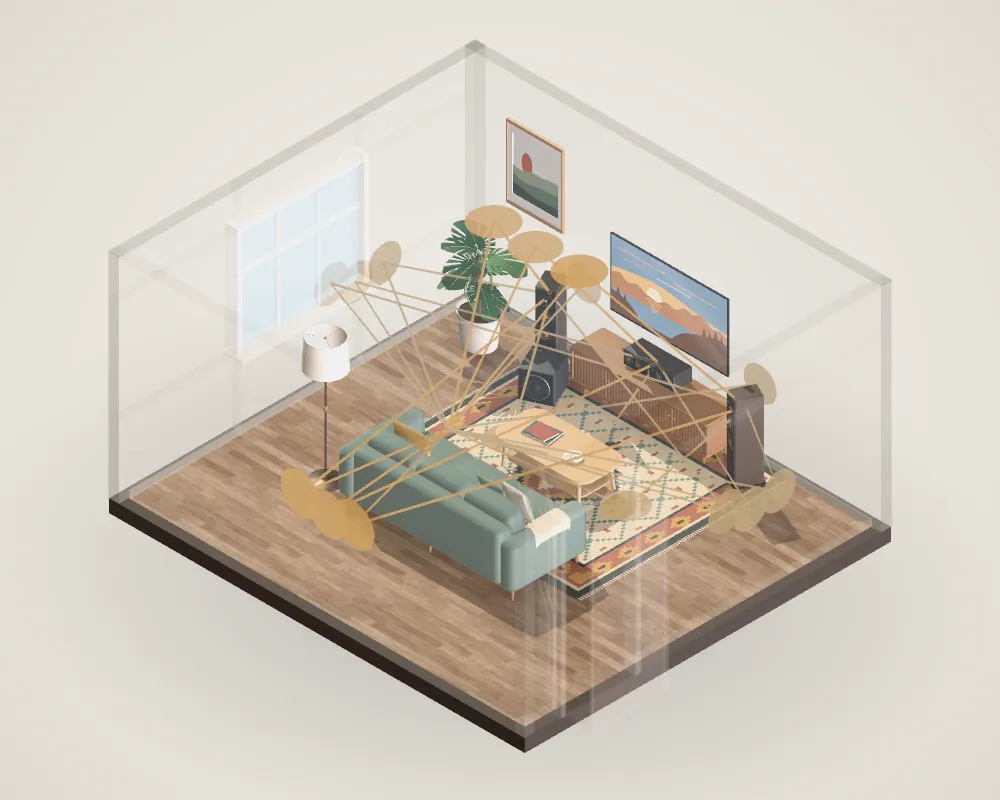
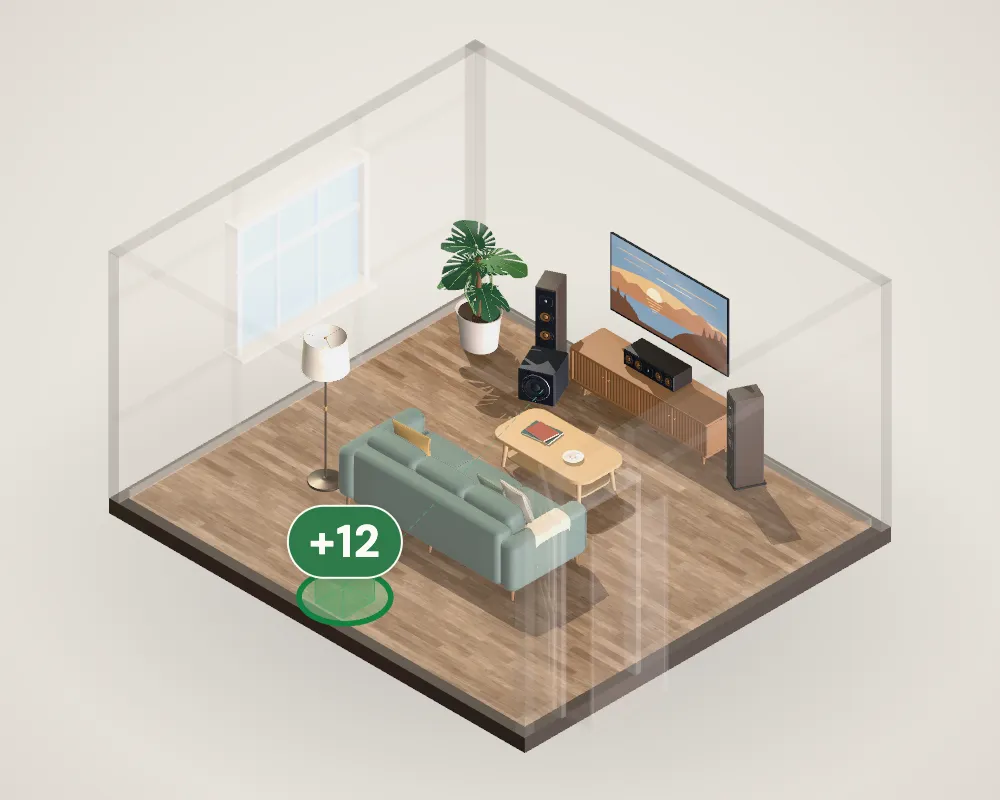
It uses the image-source method (Allen and Berkley, 1979): mirror each speaker in a surface, draw a line from your ears to the mirror image, and the point where that line crosses the surface is where the sound reflects. The extra path length gives the delay; the ratio of path lengths gives how much quieter the reflection is before any absorption.
Listening-room standards target reflections that arrive early and loud: ITU-R BS.1116 asks for reflections in the first 15 ms to be at least 10 dB below the direct sound in reference rooms, and CEDIA/CTA RP22 sets −8, −10 and −12 dB targets for its higher performance levels. In a typical living room, side-wall reflections arrive only about 3 to 10 ms after the direct sound and just 3 to 7 dB quieter, which is why panels there make the clearest difference.
Thickness matters. ROCKWOOL’s published data show a 2-inch mineral-wool board absorbing strongly from about 500 Hz up but only about a quarter of the sound at 125 Hz; a 4-inch board absorbs almost everything from 125 Hz up. Thin foam works only at higher frequencies.
Questions people ask
Where do acoustic panels go first?
At the first-reflection points on the side walls, between your front speakers and your seat. Those reflections arrive soonest and loudest. The ceiling between speakers and seat and the wall behind the seat come next.
What is the mirror trick?
Sit in your seat while someone slides a mirror along the side wall. Wherever you can see a speaker in the mirror is a first-reflection point. This tool does the same calculation.
Should every reflection be absorbed?
No. Research by Floyd Toole and others shows lateral reflections can add a pleasant sense of space, especially for music, while strong early reflections can blur dialogue and imaging. Treating the side-wall points is a common middle ground.
Sources
- Journal of the Acoustical Society of America (1979). Image method for efficiently simulating small-room acoustics (Allen & Berkley).Research
- ITU-R (2015). Recommendation ITU-R BS.1116-3: Methods for the subjective assessment of small impairments in audio systems.Standard
- CEDIA / CTA (2023). CEDIA/CTA-RP22 Immersive Audio Design Recommended Practice, v1.2.Standard
- Journal of the Audio Engineering Society / Harman (2006). Loudspeakers and Rooms for Sound Reproduction — A Scientific Review (Toole).Research
- ROCKWOOL. ROCKBOARD 40/60 multi-purpose board — sound absorption data.Measurement
Numbers on this page follow these sources. Where a figure is our own calculation or a rule of thumb, the text says so. Found a mistake? Tell us.