Bass traps: what they do, where they go, and what to expect
Bass is the hardest part of room acoustics to fix. Traps help, if they're thick enough and you know what to expect.
Bass traps are thick absorbers placed where bass pressure builds up, usually across the vertical corners of the room, and at the wall–ceiling corners. They reduce boom and shorten how long low notes ring. Thickness matters most: in ROCKWOOL’s lab test, its 4-inch mineral-wool board absorbed essentially all the sound striking it at 125 Hz and the 2-inch version about a quarter, and corner traps help less at 30–50 Hz than marketing suggests. Before buying traps, move the subwoofer and the seat: that usually fixes more than treatment can.
What bass traps do
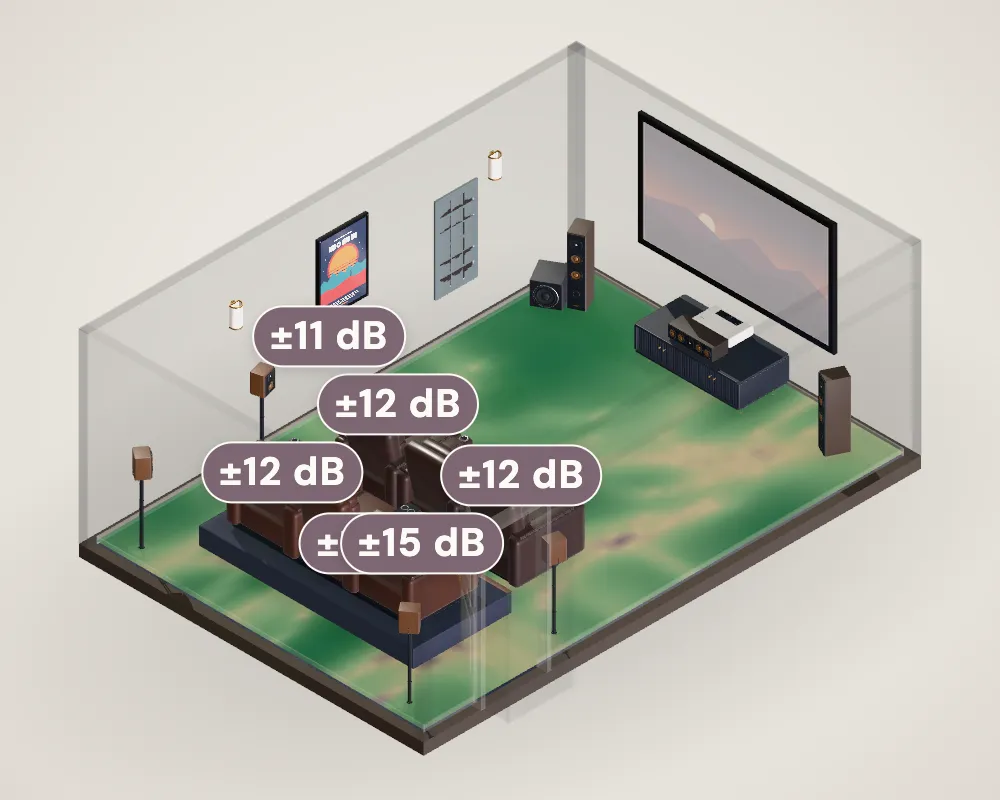
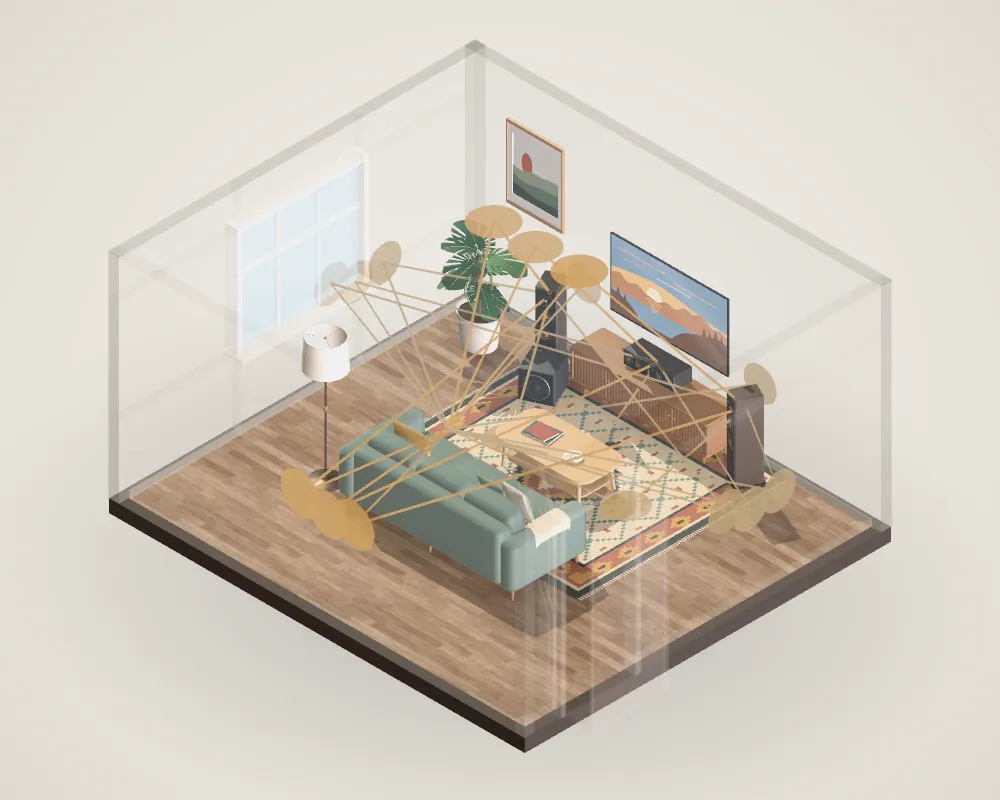
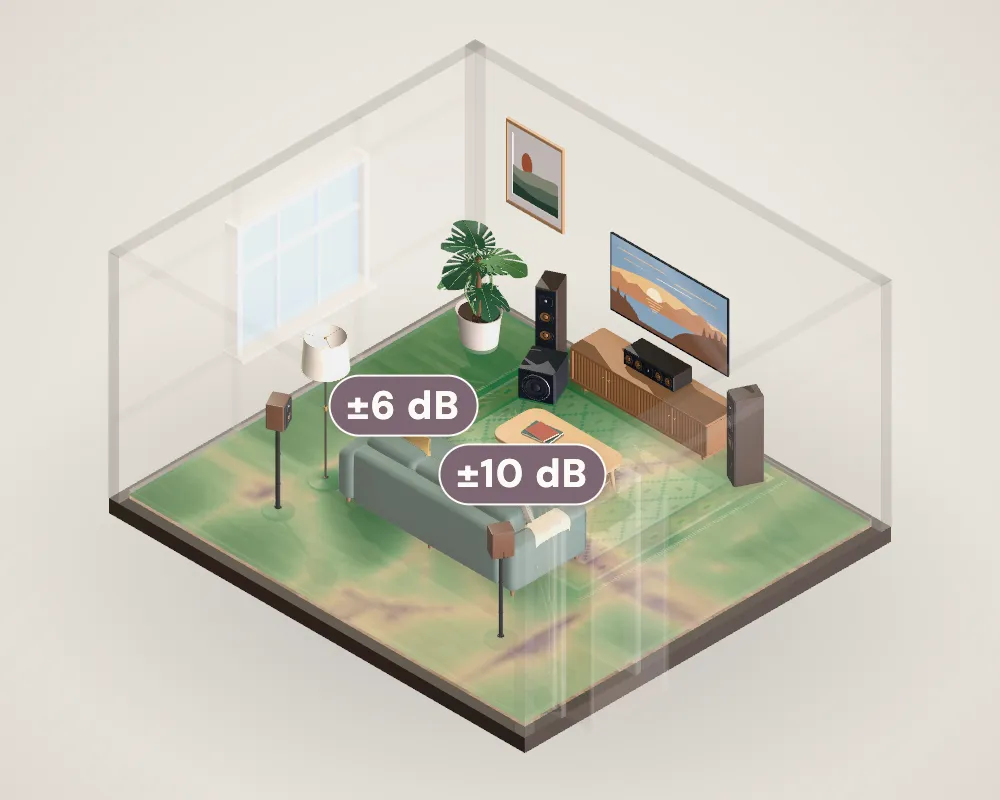
Below about 200 Hz, a room’s dimensions create standing waves (room modes): bass piles up at some frequencies and positions and cancels at others. Two symptoms follow: uneven bass (some notes boom, others vanish) and long decay (low notes keep ringing after they should stop). Bass traps absorb low-frequency energy, which tames the peaks and shortens the ringing. They do little for deep dips at your seat; those come from cancellation, and moving the seat or subwoofer changes them far more than treatment can.
Where they go
Bass pressure is highest at the room’s boundaries, and highest of all where boundaries meet. That’s why traps go in corners:
- Vertical corners, floor to ceiling if possible, front corners first (behind the speakers and sub).
- Wall–ceiling corners, especially along the front and back walls.
- Behind the front speakers and along the back wall, if corners are taken.
A trap straddling a corner also sits a little away from the walls themselves, where air moves more, which is part of why corner placement works for porous traps.
Thickness is what matters
Porous absorbers work by making air move through fibres. Bass waves are long (about 11 ft at 100 Hz), so a thin layer barely interacts with them:
| Lab-tested absorber | 125 Hz | 250 Hz |
|---|---|---|
| 2-in foam panel (Auralex SonoFlat) | 0.21 | 0.53 |
| 2-in mineral wool (ROCKWOOL ROCKBOARD 60) | 0.26 | 0.68 |
| 3-in foam panel (Auralex SonoLite) | 0.55 | 1.01 |
| 4-in mineral wool (ROCKWOOL ROCKBOARD 60) | 1.03 | 1.07 |
Absorption coefficients from each maker’s lab report. The two ROCKWOOL boards are the same material in two thicknesses, the cleanest comparison here; the Auralex panels are different products. Values above 1.0 come from the test method, not more than 100% absorption.
GIK recommends at least 4 inches for music and cinema, and an air gap behind panels to extend their reach. A corner-mounted 2-inch panel tested by Riverbank Labs for Auralex absorbed about 1.07 square meters of sound each at 125 Hz; note that a strong result at 125 Hz doesn’t guarantee much at 40 Hz.
Placement first, traps second
Treatment can’t move a cancellation. Before buying traps:
- Move the seat off the room’s exact middle and off the back wall.
- Move the subwoofer using the subwoofer crawl.
- Consider a second sub. Harman’s research found two well-placed subs nearly as effective as four at evening out bass across seats, something treatment alone can’t match.
- Then add traps to shorten the ringing and calm what’s left.
Questions people ask
Do bass traps actually work?
Yes, within limits. Thick porous traps measurably absorb bass down to around 100 Hz and somewhat below; an Auralex corner panel tested at Riverbank Labs absorbed about 1 square meter of sound per panel at 125 Hz. They’re less effective in the deepest bass, where moving the subwoofer and seat, or adding a second sub, does more.
Where should bass traps go?
In the corners, where the walls meet: the vertical corners first (floor to ceiling if possible), then the corners where walls meet the ceiling. Behind the front speakers and along the back wall are the next best places.
Are foam corner bass traps any good?
Thin foam wedges mostly absorb mid and high frequencies. Thicker, larger traps do better: ROCKWOOL’s 4-inch board measured about 1.0 at 125 Hz against 0.26 for its 2-inch board, in the same lab test. For real bass control, use the thickest traps that fit, with air space behind them.
Sources
- Auralex Acoustics (2021). Corner-mount bass trap test report (C423).Measurement
- Riverbank Acoustical Laboratories / Auralex (2013). SonoLite 3-inch bass-trap panel: sound absorption test (RAL-A13-140).Measurement
- Riverbank Acoustical Laboratories / Auralex (2013). SonoFlat 2-inch Studiofoam: sound absorption test (RAL-A13-123).Measurement
- ROCKWOOL. ROCKBOARD 40/60 multi-purpose board — sound absorption data.Measurement
- GIK Acoustics (2026). How thick should acoustic panels be?.Manufacturer
- Journal of the Audio Engineering Society / Harman (2006). Low-Frequency Optimization Using Multiple Subwoofers (Welti & Devantier).Research
- CEDIA / CTA (2023). CEDIA/CTA-RP22 Immersive Audio Design Recommended Practice, v1.2.Standard
- Room EQ Wizard. Room Simulation (modal simulator) help.Professional guide
- Journal of the Audio Engineering Society / Harman (2006). Loudspeakers and Rooms for Sound Reproduction — A Scientific Review (Toole).Research
Numbers on this page follow these sources. Where a figure is our own calculation or a rule of thumb, the text says so. Found a mistake? Tell us.