5.1 speaker placement: angles, heights and distances
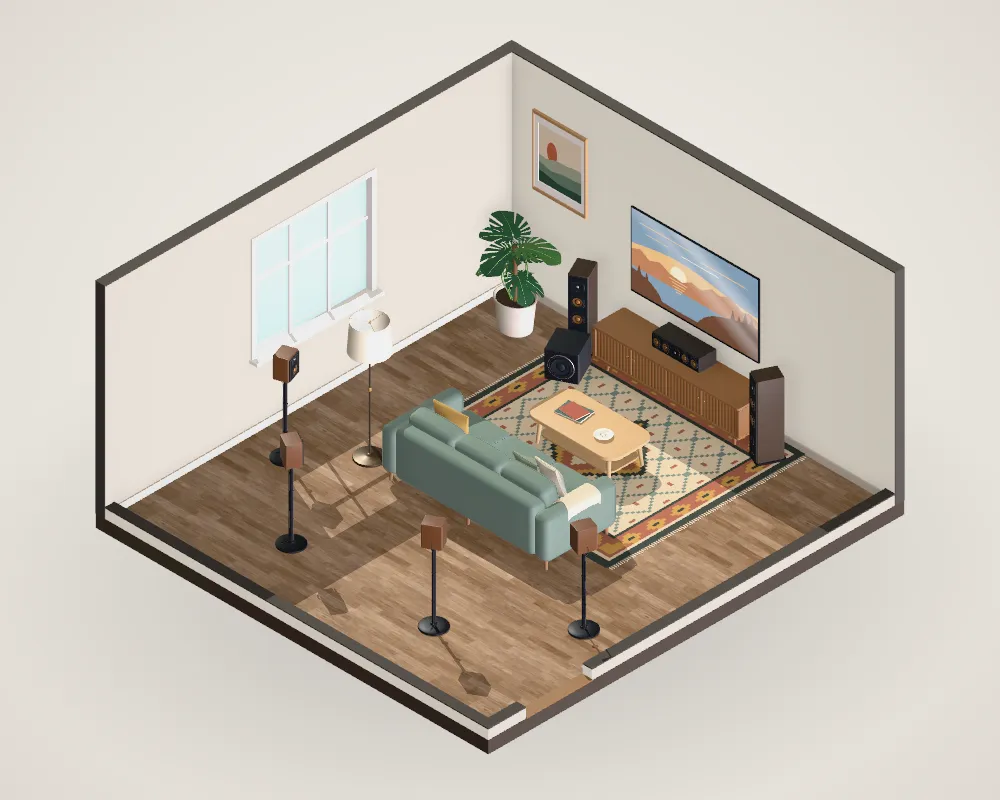
Five speakers and a subwoofer, placed by angle from your seat. Here's where each one goes and what to do when the room doesn't cooperate.
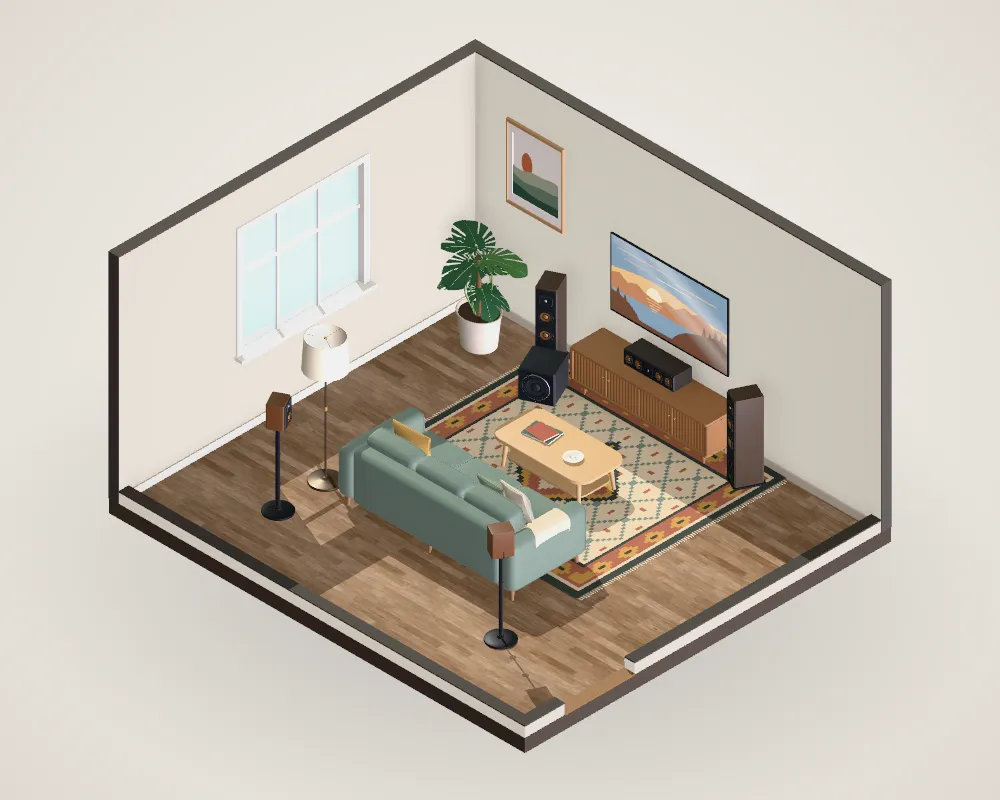
Measure angles from your main seat. Put the front left and right 22–30° either side of straight ahead (Dolby), the center directly above or below the screen and aimed at your ears, and the two surrounds at about 110°, beside you and slightly behind (anywhere from 100° to 120° is fine). Keep the fronts and surrounds at about ear height, 1.2 m (3.9 ft), ideally all at a similar distance from you, and let your receiver’s distance settings correct the rest. The subwoofer goes wherever the bass is most even, found with the subwoofer crawl.
The layout, speaker by speaker
Every angle below is measured at your head, from the line straight ahead to the screen.
| Speaker | Angle | Height | Notes |
|---|---|---|---|
| Front left / right | 22–30° | Ear level | ITU’s reference layout uses 30°. Keep them close to the screen edges so sound and picture line up. |
| Center | 0° | Just above or below the screen | Aim it at your ears; it carries most of the dialogue. |
| Surround left / right | about 110° | Ear level, up to about 1 ft above | Beside you and slightly behind; 100–120° is fine, 90° (directly beside) a workable compromise. |
| Subwoofer | Anywhere | Floor | Placement by bass evenness, not angle. |
The angle ranges come from Dolby’s installation guidelines and setup sheets; ITU-R BS.775 is the broadcast standard behind the 5.1 format. Dolby’s ear height is 1.2 m (3.9 ft), the seated ear height it takes from ITU’s listening-room recommendation.
Speaker placement plannerTurn these angles into feet and inches from your own walls and seat. Open →Front left and right
The fronts carry music and most of the action. Three things matter:
- Angle: 22–30° either side. Wider than 30° and the center of the soundstage weakens; narrower than about 22° and the stereo image shrinks.
- Distance from the wall behind them: Paradigm recommends at least 8 inches; KEF suggests 300 to 1,000 mm (about 1 to 3 feet). The further from the wall, the less the wall colors the bass, but in a living room a foot or so is usually the practical compromise.
- Toe-in: aim them toward the listening area. CEDIA/CTA RP22 asks for all speakers to point at the main seat where possible; Paradigm suggests the speakers’ axes cross just behind your head. There’s no universal toe-in angle; small adjustments change the focus of the center image.
The center speaker
The center carries most of the dialogue, so it gets its own rule: directly above or below the screen, as close to it as possible, aimed at your ears. Below the TV, tilt it up; above, tilt it down (SVS). On a console, pull it forward so its front is flush with the front edge (Klipsch); otherwise the shelf reflects sound up into it and muddies voices. See center speaker above or below the TV.
The surrounds
Surrounds carry ambience and effects. The reference placement is beside and slightly behind you, and the references don’t quite agree on how far behind: Dolby’s 2018 installation guide draws 90–110°, its current setup sheets 110–120°, and ITU-R BS.775 100–120°. Aim for about 110°, the one angle inside all three. If the sofa is near the back wall, straight beside you (90°) still works well; much past 120° and they start to sound like rear speakers.
Height is where advice conflicts:
- Dolby says ear level, and no higher than 1.25 times the height of the front speakers.
- CEDIA/CTA RP22 allows raising them about 300 mm (1 ft) in multi-row rooms so heads don’t block them.
- SVS and Klipsch suggest 2 to 3 feet above your ears for a more diffuse sound, advice that dates from before Dolby Atmos.
For a single row in a living room, ear level to about a foot above is the safe choice, and it leaves room for overhead Atmos speakers later.
The subwoofer
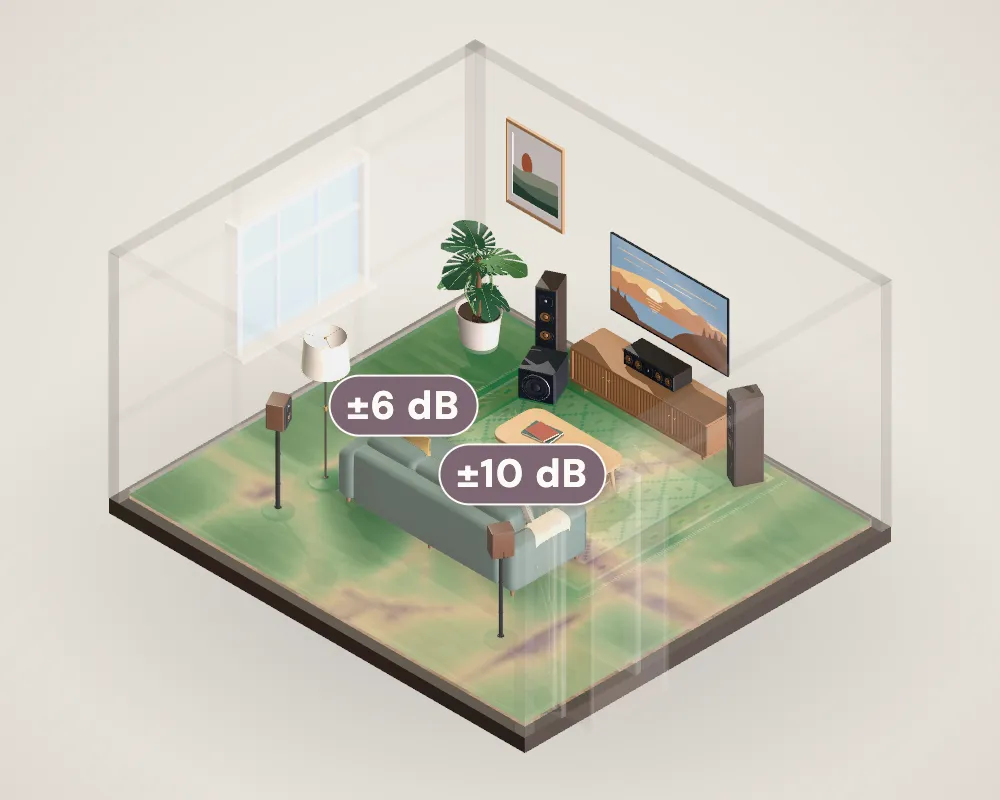
The “.1” doesn’t follow an angle. Bass below about 80 Hz is hard to locate, so the subwoofer goes wherever the bass at your seat is most even: start near the front wall or a front corner, then do the subwoofer crawl. The subwoofer simulator shows the likely good spots for your room’s shape.
Fitting it into a real living room
Living rooms rarely allow a textbook layout. In rough order of importance:
- Keep the center close to the screen. Dialogue that seems to come from the actors’ mouths matters more than anything else.
- Keep the fronts symmetrical around the screen. If one wall is closer, keep the speakers at the same angle and let the receiver handle distance.
- Get the surrounds beside you, not in front. Anywhere from about 90° to 120° works.
- Run room calibration. Every modern AV receiver measures each speaker’s distance and level from your seat. It can’t fix placement, but it fixes the differences that placement leaves.
- Then fine-tune the sub by ear or with a measurement microphone.
If you can only do one thing beyond a soundbar, a 3.1 system (left, center, right and sub) gives clearer dialogue and a wider front stage; surrounds add envelopment.
Questions people ask
Where should the surround speakers go in a 5.1 system?
Beside your seat and slightly behind it, at about 110° from straight ahead and about ear height. Dolby’s own diagrams differ: its 2018 installation guide draws 90–110°, its current setup sheets 110–120°, and ITU-R BS.775 says 100–120°. 110° is the one angle all three accept. Directly beside you (90°) is a fine compromise when the room forces it.
Can 5.1 surround speakers be in front of me?
They work best beside or slightly behind you. In front of you (less than about 90°) they blend into the front speakers and the sound loses its sense of envelopment. If the sofa is against the back wall, put them on the side walls level with your ears.
How high should 5.1 surround speakers be?
Dolby recommends ear level (about 1.2 m / 3.9 ft) and no higher than 1.25 times the height of the front speakers. Older advice from SVS and Klipsch puts them 2 to 3 feet above your head; for a modern system, and especially if you may add Atmos later, ear level to about a foot above is the better choice.
Do the speakers have to be the same distance from me?
Not exactly. Dolby suggests placing them on an arc around the seat where you can, but every AV receiver lets you set each speaker’s distance, and room calibration does it automatically. What matters more is getting the angles right.
Sources
- Dolby Laboratories (2018). Dolby Atmos Home Theater Installation Guidelines, r3.1.Manufacturer
- Dolby Laboratories. Home Theater Speaker Guide: 5.1 and 5.1.2 setup sheets.Manufacturer
- ITU-R (2012). Recommendation ITU-R BS.775-3: Multichannel stereophonic sound system with and without accompanying picture.Standard
- CEDIA / CTA (2023). CEDIA/CTA-RP22 Immersive Audio Design Recommended Practice, v1.2.Standard
- SVS. Speaker Placement Guide for Home Audio.Manufacturer
- SVS. Center Channel Speaker Placement Tips.Manufacturer
- Klipsch (2021). How to set up Klipsch speakers.Manufacturer
- Paradigm (2019). Where should I place speakers?.Manufacturer
- KEF. 10 tips for speaker placement.Manufacturer
- ITU-R (2015). Recommendation ITU-R BS.1116-3: Methods for the subjective assessment of small impairments in audio systems.Standard
Numbers on this page follow these sources. Where a figure is our own calculation or a rule of thumb, the text says so. Found a mistake? Tell us.