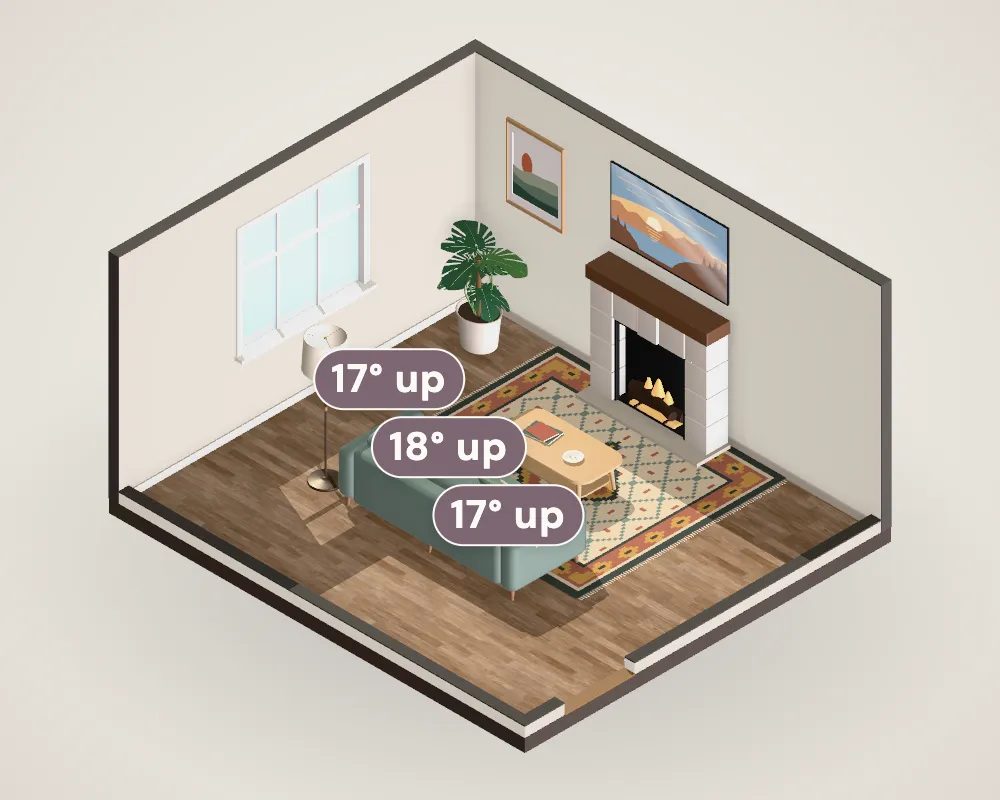
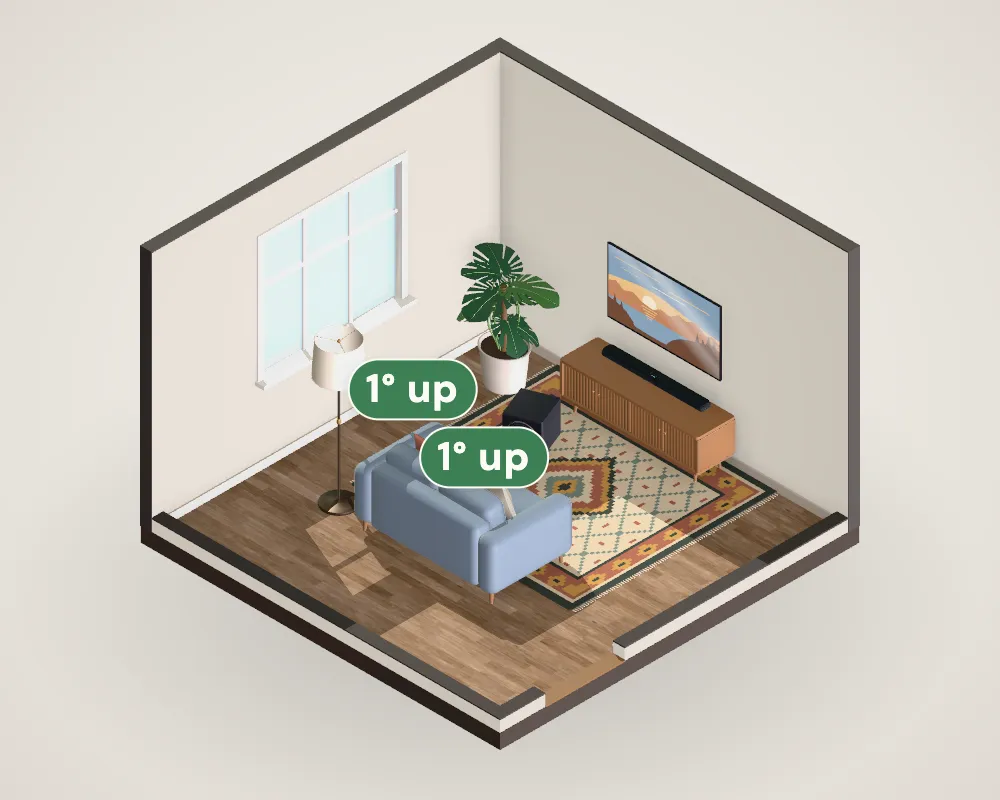
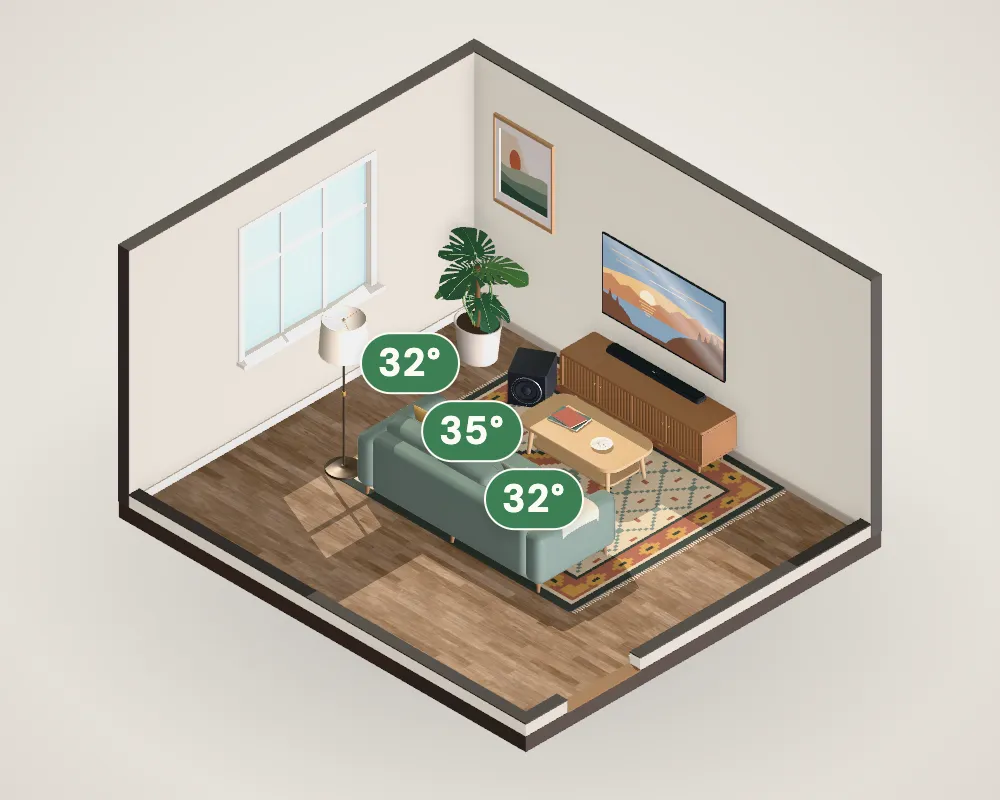
How high to mount a TV
The short version is 42 inches to the center of the screen. The useful version accounts for your seat, your distance and your TV's size.
For a sofa, mount the TV so the center of the screen is about 42 inches from the floor, roughly a seated adult’s eye height (Samsung’s guidance). For a 65-inch TV that puts the bottom edge of the picture about 26 inches up; for a 55-inch, about 28.5; for a 75-inch, about 23.5. Higher is fine within limits: THX suggests keeping the screen center within 15° of your eye line, which allows a center up to about 68 inches from 8 feet away and 74 inches from 10 feet. In a bedroom, measure your eye height sitting in bed; it’s usually well above 42 inches.
The 42-inch rule, and where it comes from
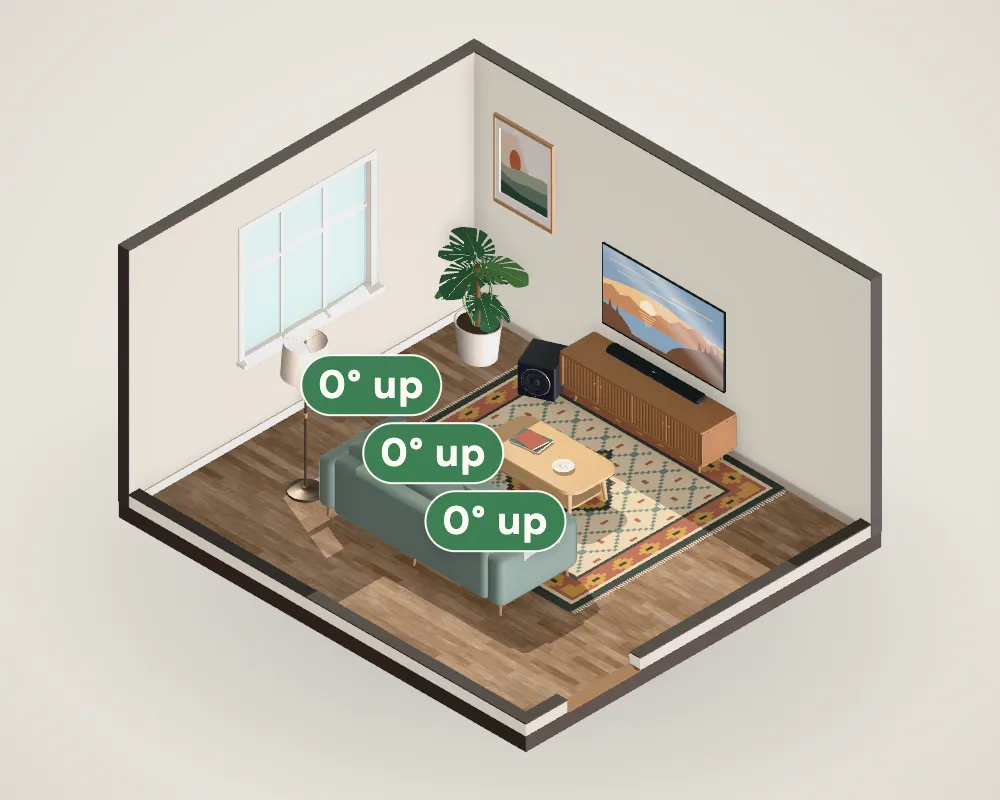
Samsung’s wall-mounting guidance puts the center of the screen about 42 inches from the floor, which matches the eye height of an average adult sitting on a typical couch. It’s a rule of thumb rather than a measurement of you: your sofa’s seat height and your own height move it by a few inches either way. The best anthropometric data (the US Army’s ANSUR II survey) puts the median seated eye height at about 29.5 inches above the seat for women and 31.7 inches for men, measured sitting upright. Add a sofa seat about 18 inches high and an upright adult’s eyes are 47 to 49 inches from the floor; cushions compress and most of us slouch on a sofa, which brings that down toward Samsung’s 42. That’s why a screen centered anywhere from about 42 to 48 inches feels natural.
For a sofa, then, measure the seat height, add about 25 inches if you’re unsure, or simply sit down and have someone measure from the floor to your eyes. That’s your target for the center of the screen.
Height by TV size
With the screen’s center at 42 inches, here is where the picture’s edges land. Real TVs add a thin frame, usually under half an inch, and sometimes a slightly deeper bottom edge.
| TV size | Picture height | Bottom edge | Top edge |
|---|---|---|---|
| 43 in | 21.1 in | 31.5 in | 52.5 in |
| 50 in | 24.5 in | 29.7 in | 54.3 in |
| 55 in | 27.0 in | 28.5 in | 55.5 in |
| 65 in | 31.9 in | 26.1 in | 57.9 in |
| 75 in | 36.8 in | 23.6 in | 60.4 in |
| 85 in | 41.7 in | 21.2 in | 62.8 in |
| 98 in | 48.0 in | 18.0 in | 66.0 in |
Large TVs hit a practical floor: an 85-inch TV centered at 42 inches leaves only about 21 inches under the picture, less than the height of many consoles. In practice the screen sits just above the furniture, and that’s fine.
If there’s a soundbar under the TV, leave the gap its maker asks for: Sonos says at least 4 inches between an Arc Ultra and the TV and 2 inches for a Beam (Gen 2); Samsung asks for 5 cm (2 in) for a wall-mounted HW-Q990F. That gap pushes the TV up a little.
How high is too high?
The best-known limit comes from THX: keep your line of sight within 15° of the screen’s center. Because it’s an angle, the further back you sit, the higher the TV can go:
| Eye-to-screen distance | Highest center within 15° |
|---|---|
| 6 ft | 61 in |
| 8 ft | 68 in |
| 10 ft | 74 in |
| 12 ft | 81 in |
Two other references are useful for context. Cinema designers (the UNIC handbook) allow up to 25° to the screen center for the front row, the least comfortable seats in the house. Ergonomic standards for computer screens (ANSI/HFES 100) go the other way and recommend the screen sit below eye level, noting that looking up with the head tilted back can cause discomfort. Watching TV isn’t office work, but the direction of the advice is clear: slightly low beats high.
TV mounting height calculatorYour seat, your distance, your TV: get the center and bottom-edge heights, and the angle. Open →
Bedrooms, kitchens and gaming setups
Bedrooms. You sit higher in bed than on a sofa, so the TV should go higher too. As an example, sitting upright on a mattress about 25 inches high puts most adults’ eyes about 54 to 57 inches from the floor (25 inches plus the ANSUR II median seated eye heights). Propped up on pillows and leaning back, your eyes drop and your head tilts back, so a center around your upright eye height, or slightly above it, usually works. Measure from the bed itself.
Kitchens and standing areas. When you mostly watch standing, eye height is much higher: ANSUR II puts median standing eye height at about 60 inches for women and 65 inches for men. A kitchen TV centered around 60 inches suits most people standing at a counter.
Recliners and gaming chairs. Reclining drops your eyes by roughly 2 to 6 inches (the UNIC handbook gives 50–150 mm) and tips your head back. If everyone watches reclined, a center an inch or two lower than the sofa figure works well.
Mounting it safely
A few facts matter more than any height rule:
- Find the studs. US homes usually have studs 16 or 24 inches apart, but not always, so locate them. Mount makers’ manuals typically require lag bolts into the center of the studs; SANUS’s VLT5 manual does.
- Read your mount’s drywall rules. Some mounts allow toggle anchors in drywall when the wall can carry the load; others forbid it. SANUS’s VLF628 full-motion mount says do not install into drywall alone and requires a wall that can hold five times the TV plus the mount.
- Masonry is not all the same. Vogel’s separates solid brick and concrete from perforated brick and hollow block, which need different fixings. SANUS warns never to drill into the mortar between blocks.
- Match the VESA pattern and weight. The VESA pattern is the spacing of the mounting holes, in millimeters (for example 300 × 300). Check both the pattern and the weight rating against your TV’s specification.
- Anchor TVs on furniture. The US Consumer Product Safety Commission says to anchor both TVs and furniture to the wall; it counted 217 tip-over deaths from January 2013 to July 2023, 47% of them involving a TV.
Questions people ask
How high should a 65-inch TV be mounted?
With the center of the screen at 42 inches, the picture’s bottom edge is about 26 inches from the floor and its top about 58 inches. If it sits above a console, a center between 42 and 50 inches is common; from 8 feet away anything up to about 68 inches stays within THX’s 15° guideline.
How high should a TV be mounted in a bedroom?
Higher than in a living room, because you sit higher in bed. Sit where you’ll watch and measure from the floor to your eyes; aim the screen’s center at that height or slightly above. Sitting upright on a mattress about 25 inches high, most adults’ eyes are roughly 54–57 inches from the floor.
Is eye level the right height for a TV?
For seated viewing, yes: the center of the screen at your seated eye height means you look straight ahead. A little higher is fine; ergonomic guidance for computer screens even prefers slightly below eye level. What causes neck strain is a screen well above eye level that you watch for hours.
How far below the ceiling should a TV be?
There’s no rule for ceiling distance; the screen height is set by your eyes, not the ceiling. In a room with an 8-foot ceiling, a 65-inch TV centered at 42 inches leaves about 38 inches above it.
Can I mount a TV on drywall without studs?
Check your mount’s manual first. Some allow toggle anchors if the wall can carry the load; SANUS’s VLF628 full-motion mount says not to install into drywall alone and requires a wall that holds five times the TV and mount weight. Studs (usually 16 or 24 inches apart in US homes) or solid masonry are the safe default.
Sources
- Samsung US Support. Where to mount the TV.Manufacturer
- THX. Viewing Guide FAQ.Professional guide
- International Union of Cinemas (UNIC) (2021). UNIC Cinema Technology Handbook (v2).Professional guide
- Human Factors and Ergonomics Society (2007). ANSI/HFES 100-2007 Human Factors Engineering of Computer Workstations (§5.2.4.3).Standard
- US Army Natick / Penn State Open Lab (2012). ANSUR II Anthropometric Survey of US Army Personnel (public data).Measurement
- Sonos. Sonos Arc Ultra user guide (placement).Manufacturer
- Sonos. Sonos Beam (Gen 2) user guide (select a location).Manufacturer
- Samsung (2025). HW-Q990F / Q930F / Q800F user manual.Manufacturer
- VESA. Flat Display Mounting Interface (FDMI) overview.Standard
- SANUS. VLT5 tilting wall mount: instruction manual.Manufacturer
- SANUS. VLF628 full-motion mount: instruction manual.Manufacturer
- Vogel’s (2025). TV on the wall: wall types.Manufacturer
- US Consumer Product Safety Commission (2024). CPSC reminds families to tackle the deadly hazard of TV and furniture tip-overs (release 24-115).Government
Numbers on this page follow these sources. Where a figure is our own calculation or a rule of thumb, the text says so. Found a mistake? Tell us.