Surround sound in an open-plan room
No back wall, no side wall, a kitchen behind the sofa. Here's how to get surround sound anyway.
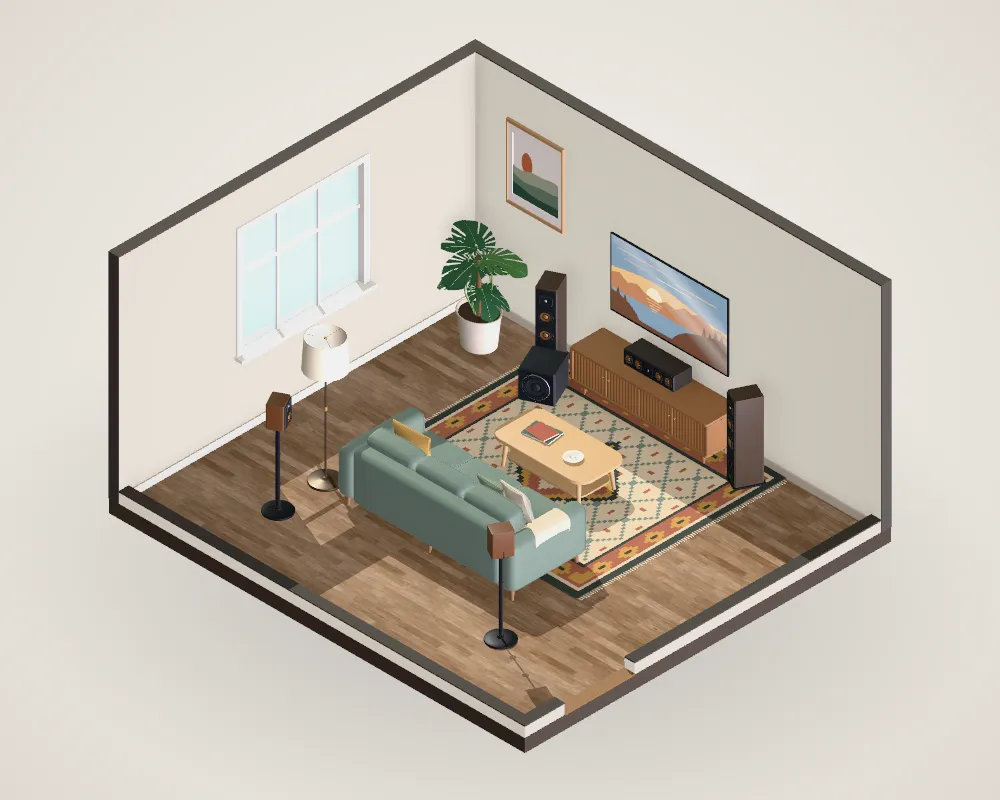
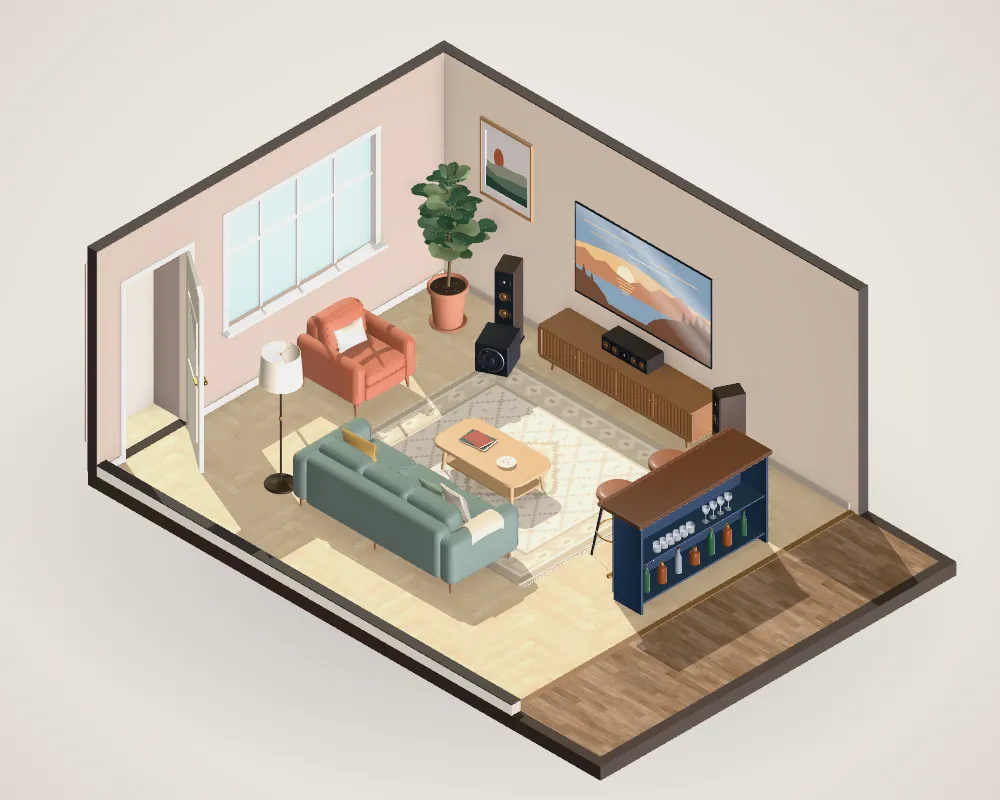
In an open-plan room, put the speakers where the walls are. A 3.1 system (left, center, right and subwoofer) on the TV wall gives clear dialogue and a wide front stage with nothing in the walkways. For surround, use wireless or stand-mounted surrounds beside or just behind the seats (90–110°) rather than rears in the kitchen, or add height speakers in the ceiling. Bass leaks into the open space, so it usually takes more subwoofer output to sound the same; a dedicated center speaker keeps voices clear over kitchen noise.
Start with the front three
In an open room, the TV wall is often the only full wall you have, so it should carry the system:
- Front left and right 22–30° either side of straight ahead from the main seat (Dolby), close to the screen edges.
- A center speaker directly above or below the screen, aimed at your ears. In an open-plan room it matters more than usual: it keeps dialogue clear over the dishwasher and conversation in the kitchen.
- A subwoofer placed for even bass at the seat (see the subwoofer crawl).
That’s 3.1, and in many open-plan rooms it’s the right finished system.
Adding surround without a back wall
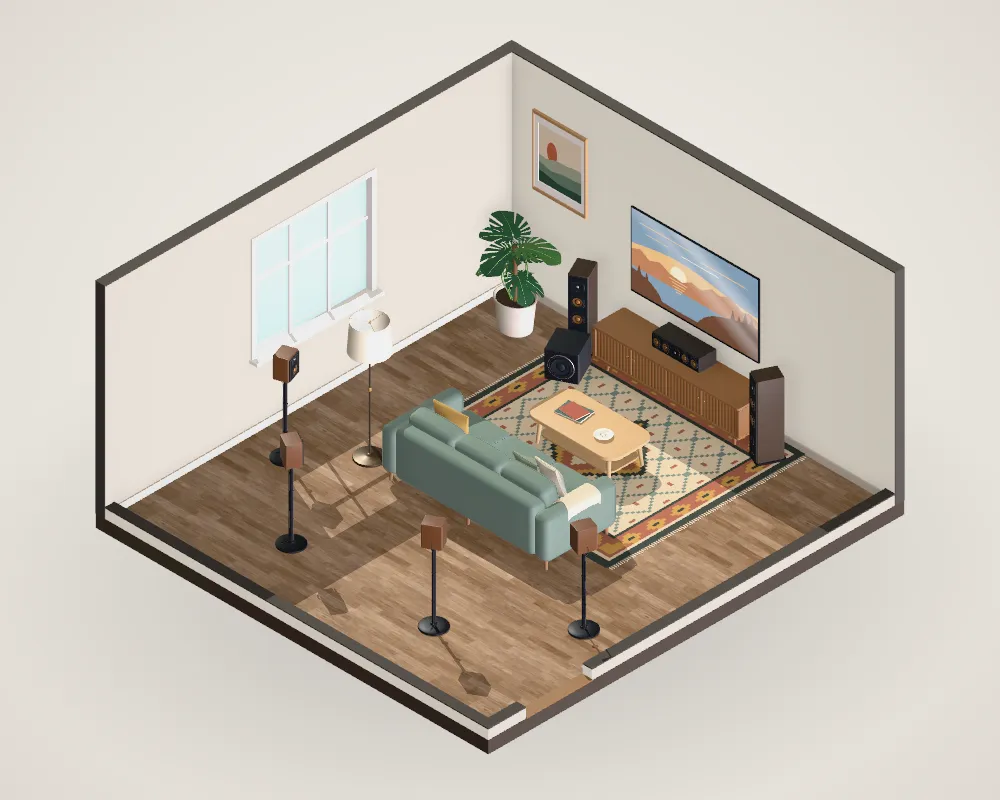
Surrounds belong beside you and slightly behind. We’d aim for about 110°, the one angle Dolby’s diagrams and the ITU standard all accept; straight beside the sofa (90°) is a fine compromise when there’s nothing behind it. Options when there’s no wall there:
- Stands at the ends of the sofa, at about ear height, aimed at the seat. Dark stands disappear more than you’d expect.
- Wireless surrounds from a soundbar or wireless speaker system: they still need power, but no speaker cable across the floor. Sonos’s guidance is behind and to either side of the usual seat.
- Height speakers in the ceiling above and slightly in front of the seating (5.1.2). They add envelopment without anything on the floor, and the ceiling is usually continuous even when the walls aren’t.
Avoid rear surrounds in a walkway or kitchen: they’ll be at very different distances from the seats, in the way, and loud for anyone cooking.
How the open side changes the sound
- Bass: with one side open, bass energy spreads into the connected space rather than building up between parallel walls, so you get less of it for the same subwoofer; a closer subwoofer position helps. The two spaces also act as one coupled system, which moves the peaks and dips around in ways a simple model can’t predict.
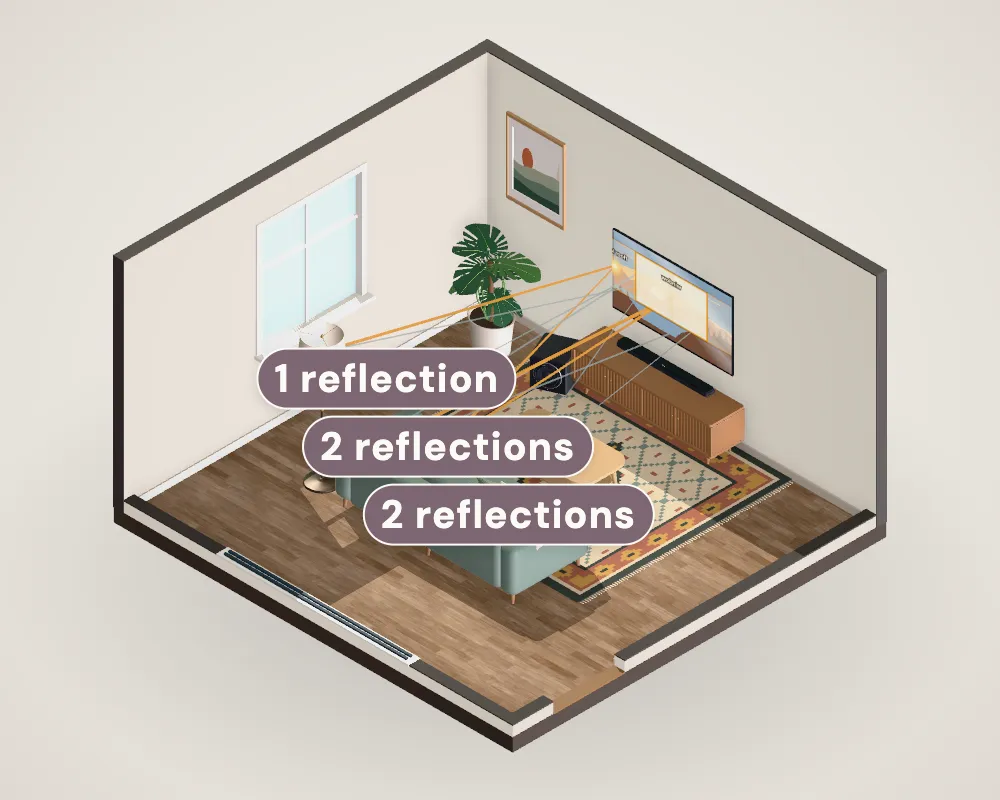
- Reflections: the open side doesn’t reflect, so the room sounds less boxy, but the remaining walls are often hard glass and tile. A rug under the seating and curtains on big windows help.
- Imaging: asymmetric rooms pull the sound toward the walled side. Keep the left and right speakers at the same angle from the seat and let room calibration balance the levels.
Questions people ask
Can you have surround sound in an open-plan living room?
Yes. Keep the front speakers on the TV wall, put surrounds on stands or wireless surrounds beside the seats, and consider in-ceiling height speakers. Rear speakers in a kitchen or walkway are usually more trouble than they’re worth.
Is a soundbar or 3.1 better for an open-plan room?
Both work. A soundbar is simplest; a 3.1 system with a dedicated center speaker gives clearer dialogue and a wider front stage, which helps over kitchen and household noise.
Why is the bass weaker in my open-plan room?
Bass spreads into the connected space instead of building up between walls, so the same subwoofer sounds quieter. A slightly larger subwoofer, or one placed closer to the seating, compensates. Don’t assume the bass is also more even: the peaks and dips move rather than disappear, so check it at the seat.
Sources
- Dolby Laboratories (2018). Dolby Atmos Home Theater Installation Guidelines, r3.1.Manufacturer
- ITU-R (2012). Recommendation ITU-R BS.775-3: Multichannel stereophonic sound system with and without accompanying picture.Standard
- CEDIA / CTA (2023). CEDIA/CTA-RP22 Immersive Audio Design Recommended Practice, v1.2.Standard
- Sonos. Surround sound guidelines and limitations.Manufacturer
- SVS. The Art of Subwoofer Placement.Manufacturer
- KEF (2025). Phase and positioning: where to place a subwoofer.Manufacturer
Numbers on this page follow these sources. Where a figure is our own calculation or a rule of thumb, the text says so. Found a mistake? Tell us.